

Every October, the financial news cycle gets entirely taken over by a single percentage. Headlines blast the new Social Security Cost of Living Adjustment (COLA), and millions of retirees quickly try to calculate exactly how much extra cash will hit their bank accounts starting in January.
Table Of Content
- How the 2026 COLA is Actually Calculated
- What the 2.8% Means for the Average Check
- The Catch: Medicare Part B Premiums
- The Real Math: Before and After
- The Stealth Tax: Combined Income Thresholds
- The $184,500 Taxable Wage Base (For Those Still Working)
- What This Means for Your Paycheck
- Does the COLA Affect My Claiming Strategy?
- How I Factor the 2026 Raise into My Own Strategy
- Action Steps for Right Now
For 2026, that headline number is 2.8%.
When I first started looking at retirement planning, I used to take these headline numbers at face value. A 2.8% raise sounds straightforward enough. If you get a 2.8% raise at a corporate job, your paycheck goes up by exactly that amount, minus standard taxes.
But I’ve learned that in the world of fixed income and government benefits, headline numbers rarely tell the whole story.
What finally made this click for me was realizing that your Social Security check doesn’t exist in a vacuum. It is deeply tied to Medicare premiums, complicated inflation metrics, and tax thresholds that quietly erode the actual purchasing power of your money.
If you want to understand exactly what the 2026 social security increase means for your real-world wallet, we need to look past the 2.8% headline and do the actual math.
How the 2026 COLA is Actually Calculated
Before we look at the dollars and cents, it helps to understand why the 2026 COLA is 2.8%—a slight bump up from the 2.5% we saw in 2025.
The government doesn’t just guess at this number or vote on it. It’s driven by a highly specific math formula tied to inflation. But here is the catch: it isn’t tied to the inflation you and I experience at the grocery store or the pharmacy.
It is tied to a metric called the CPI-W (the Consumer Price Index for Urban Wage Earners and Clerical Workers).
The Social Security Administration looks at the CPI-W during the third quarter of the year (July, August, and September). They compare it to the same three months of the previous year. If costs went up, benefits go up by that exact percentage.
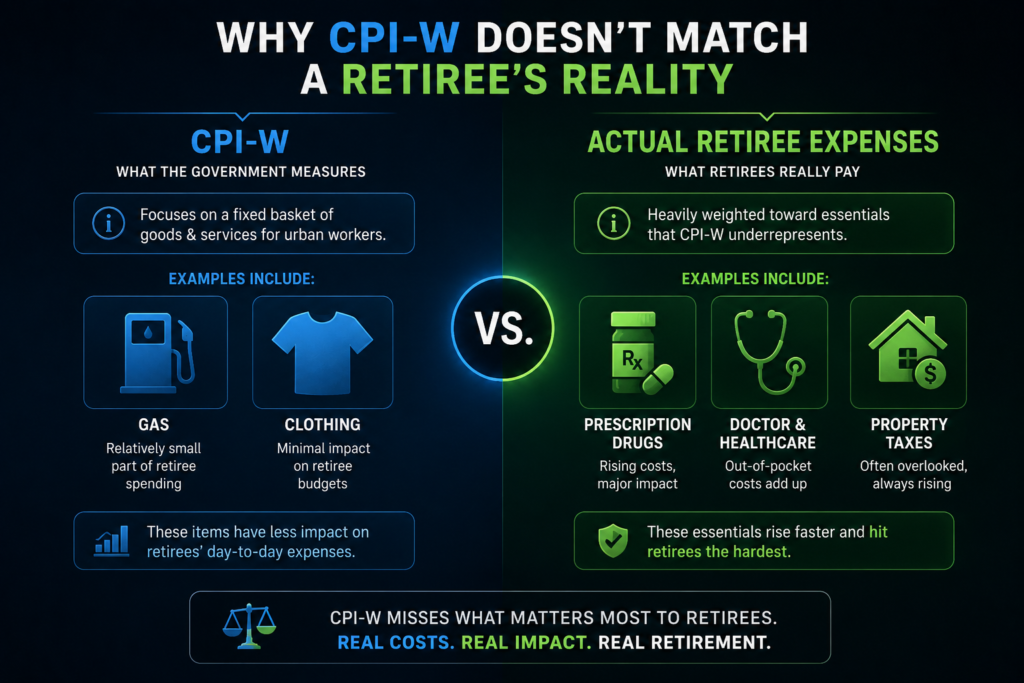
Here is why this matters to you: the CPI-W measures the spending habits of younger, working-age people. It heavily weights things like commuting costs, gas, and apparel. It historically places a much lower weight on healthcare, prescription drugs, and housing—which happen to be the exact things retirees spend the vast majority of their money on.
So, while a 2.8% increase is mathematically accurate based on the CPI-W, it often feels completely inadequate if your Medicare premiums and property taxes are rising by 6% or 7% a year. This mismatch is exactly why I personally build my retirement spreadsheets with a heavy buffer. You simply cannot rely on the COLA to completely protect your purchasing power.
What the 2.8% Means for the Average Check
Let’s look at the actual dollars.
For 2026, the 2.8% Social Security cost of living adjustment raises the average retirement check to roughly $2,071 per month.
Compared to the average baseline in 2025, that translates to an average gross increase of about $56 a month.
Notice that I used the word gross. This is the biggest mistake I see people make when planning their January budget. They take their current check, multiply it by 1.028, and assume that’s what will be deposited into their checking account.
That is rarely what actually happens.
The Catch: Medicare Part B Premiums
If there is one thing I want you to take away from this breakdown, it’s this: Medicare gets paid first.
Most retirees have their Medicare Part B premiums (which cover doctor visits and outpatient services) deducted automatically from their Social Security checks before the money ever leaves the government’s hands.
When Social Security announces a cost of living increase, Medicare typically announces premium increases right around the same time. Because healthcare costs generally rise faster than standard consumer goods, the Medicare Part B premium increase almost always eats into a significant chunk of your Social Security raise.
Let’s look at a hypothetical scenario to show exactly how this “leaky bucket” works in practice.
The Real Math: Before and After
Imagine a retiree whose gross Social Security benefit was $2,000 a month in 2025. Here is how the 2.8% raise actually plays out once Medicare takes its share.
Note: The Medicare Part B premiums used here are illustrative estimates based on standard premium indexing, as final Part B brackets often shift.
| Category | 2025 (Last Year) | 2026 (New Year) | Difference |
| Gross Benefit | $2,000.00 | $2,056.00 | + $56.00 |
| Medicare Part B Deduction | -$174.70 | -$185.00 (est.) | – $10.30 |
| Net Bank Deposit | $1,825.30 | $1,871.00 | + $45.70 |
As you can see, the headline says you are getting $56 more. But your actual bank deposit only goes up by about $45.
For some retirees, particularly high-income earners who are subject to Medicare IRMAA surcharges, the math is even worse. An increase in your Medicare premium can completely wipe out your COLA, leaving your net check exactly the same—or even slightly lower—than the year before.
This is exactly why I advise treating the annual Social Security increase as a mild inflation shock absorber, rather than a true raise.
The Stealth Tax: Combined Income Thresholds
There is another hidden consequence to the 2026 COLA that catches a lot of retirees off guard.
When your gross Social Security benefit goes up, it can push you over the threshold where your benefits become taxable.
The IRS uses a formula called “Combined Income” to determine if you owe taxes on your Social Security. Your Combined Income is your Adjusted Gross Income (AGI) plus non-taxable interest, plus half of your Social Security benefits.
If you file as an individual and your Combined Income is over $25,000, up to 50% of your benefits can be taxed. If it’s over $34,000, up to 85% can be taxed. (For married couples filing jointly, those thresholds are $32,000 and $44,000).
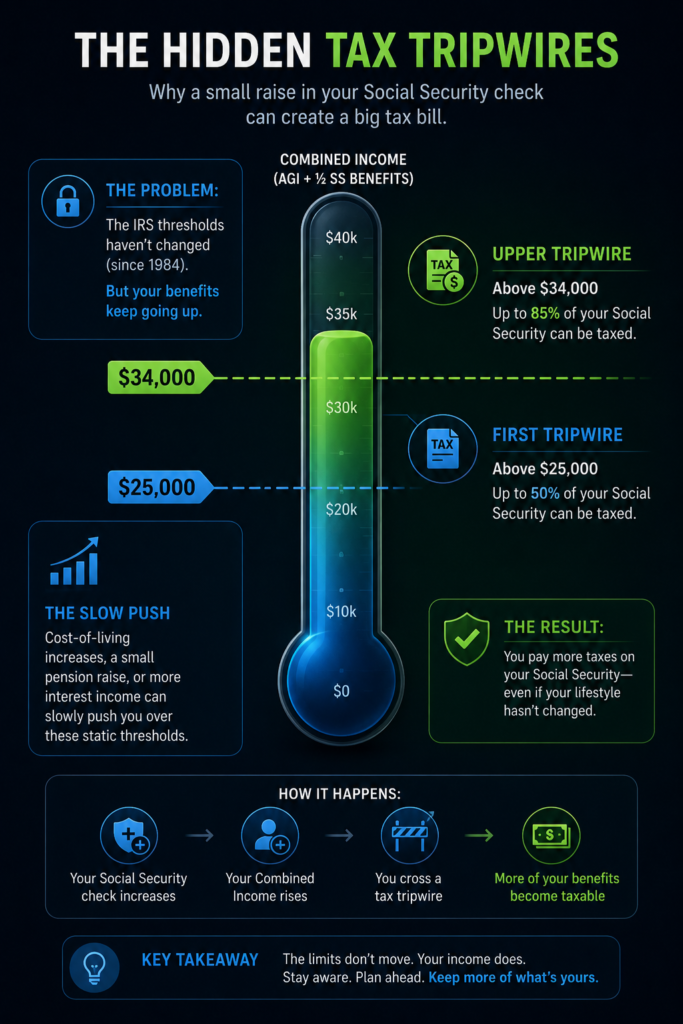
Here is the infuriating part: unlike tax brackets or contribution limits, these Combined Income thresholds are not indexed to inflation. They have been stuck at the exact same dollar amounts since the 1990s.
Because the thresholds never change, every time you get a Social Security cost of living adjustment, your Combined Income creeps higher. Over the years, COLA raises push more and more retirees over those unmoving tripwires, turning previously tax-free benefits into taxable income.
I personally factor this “stealth tax” into all long-term planning. If you are drawing income from a traditional 401(k) or IRA while taking Social Security, you have to monitor these thresholds closely.
The $184,500 Taxable Wage Base (For Those Still Working)
The Social Security COLA doesn’t just impact retirees. It directly impacts the paychecks of millions of working professionals.
If you are still working, you pay a 6.2% FICA tax on your income to fund Social Security. However, you don’t pay this tax on every single dollar you earn. The government caps the amount of income subject to this tax. This is known as the Social Security Taxable Wage Base.
Because benefits are going up, the government needs to collect more money to fund them. So, the wage base goes up too.
In 2025, the wage base was capped at $176,100. In 2026, that cap jumps significantly to $184,500.
What This Means for Your Paycheck
If you earn under $176,100, this change means absolutely nothing to you. You will pay your standard 6.2% tax on your wages just like you always have.
But if you are a high earner making $184,500 or more, you are going to feel this in your paycheck.
Let’s do the math:
- In 2025, the maximum Social Security tax an employee paid was $10,918.20 (6.2% of $176,100).
- In 2026, the maximum tax an employee will pay is $11,439.00 (6.2% of $184,500).
That is an extra $521 out of your pocket over the course of the year.
If you are self-employed, the impact is doubled. Because self-employed individuals pay both the employer and employee portions of the FICA tax (12.4%), a self-employed high earner will pay over $1,000 more in Social Security taxes in 2026 than they did in 2025.
When I look at my own business revenue, these are the kinds of moving targets I watch closely. An extra thousand dollars in payroll taxes might not break a business, but it’s money that could have been maxing out a backdoor Roth IRA or funding a brokerage account.
Does the COLA Affect My Claiming Strategy?
One of the most common questions I hear from people in their early 60s is: “Should I claim my benefits now to make sure I lock in this COLA?”
The short answer is no. You do not need to claim your benefits to get the raise.
The Social Security Administration calculates your baseline benefit (your Primary Insurance Amount, or PIA) based on your highest 35 years of earnings. Once you turn 62, every single annual COLA is automatically applied to your underlying record, whether you have claimed the benefit or not.
If you wait until you are 67 or 70 to claim, your eventual monthly check will include the compounded growth of every COLA that was announced while you were waiting. Waiting to claim actually magnifies the effect of the COLA, because the percentage increases are applied to a larger baseline benefit.
How I Factor the 2026 Raise into My Own Strategy
Understanding the mechanics of the 2026 Social Security increase completely changed how I view retirement income.
I used to think of Social Security as a guaranteed inflation-adjusted floor. Now, I view it as a incredibly helpful, but flawed, income stream that requires a solid backup plan.
Because the CPI-W doesn’t track retiree healthcare costs accurately, and because Medicare premiums constantly eat into the gross raise, you cannot expect your Social Security check to keep pace with your actual cost of living over a 20 or 30-year retirement.
This is exactly why personal investments are so critical. In my own portfolio, I rely on a mix of dividend-paying equities and fixed-income assets to outpace true inflation, rather than waiting on the government to do it for me.
Action Steps for Right Now
If you want to get a firm grip on your numbers for 2026, here is what I recommend doing this week:
- Log into your my Social Security account: The SSA usually makes your personalized 2026 COLA notice available in your online portal by early December. Don’t wait for the paper letter.
- Check your net number: Look specifically at the line item for your Medicare Part B deduction so you know exactly what your actual bank deposit will be in January.
- Review your tax withholding: If this 2.8% raise pushes your Combined Income higher, you might want to voluntarily withhold taxes from your Social Security check (using Form W-4V) so you don’t end up with a surprise tax bill in April.
The 2026 COLA of 2.8% is certainly better than nothing. But by understanding the real math behind the Medicare deductions and the taxable wage base, you can plan your budget based on reality, not just the headlines.





No Comment! Be the first one.