

I can still vividly remember the first time I Googled how much money I was supposed to have saved for retirement. I was in my early thirties, finally making a decent income after spending my twenties climbing out of student loan debt, and I decided it was time to get serious about my financial future.
Table Of Content
- The Standard Retirement Benchmarks
- Why These Benchmarks Are Fundamentally Flawed
- The Debt Blind Spot
- The Cost of Living Illusion
- The Single vs. Dual Income Gap
- Ignoring Other Assets and Income Streams
- How You Should Actually Measure Your Progress
- The Real Catch-Up Plan (If You Are Actually Behind)
- The Standard 50+ Catch-Up
- The New 2026 “Super” Catch-Up for Ages 60-63
- The New Roth Catch-Up Mandate for High Earners
- My Checklist: What to Do When You Feel Behind
- Final Thoughts
I found one of those standard benchmark tables published by a massive brokerage firm. I cross-referenced my age with my salary, expecting to feel a small sense of pride about the 401(k) balance I had just started building.
Instead, my stomach dropped. According to the chart, I was massively behind.
If you are reading this, there is a very good chance you have experienced that exact same feeling. Every January, financial media loves to publish these benchmark tables. They tell you exactly how many multiples of your salary you should have tucked away in your investment accounts by the time you blow out the candles on your 30th, 40th, or 50th birthday.
These tables are designed to give you a quick gauge of your financial health. But over my years of investing and managing my own portfolio, I’ve learned that these generic milestones often do more harm than good. They induce panic, they ignore the reality of modern personal finance, and frankly, they are mostly wrong.
Today, we are going to look at the standard 2026 retirement benchmarks so you know what the industry expects. But more importantly, we are going to break down why these numbers are heavily flawed, how you should actually be measuring your progress, and exactly what to do if you feel like you are falling behind.
The Standard Retirement Benchmarks
Before we tear the conventional wisdom apart, we need to understand what it actually is.
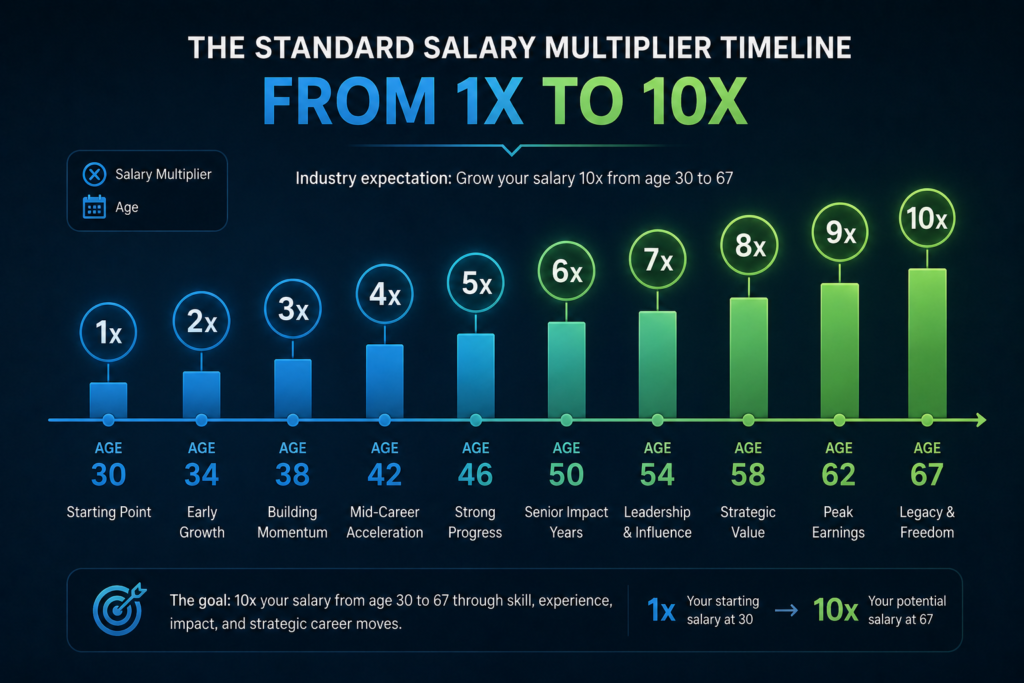
When financial planners and major institutions like Fidelity talk about retirement readiness, they usually use a salary-multiple framework. The idea is simple: instead of aiming for a random dollar amount like $1 million, you aim to save a specific multiple of your current gross income by a certain age.
This makes sense in theory because your current income usually dictates your current lifestyle, and your retirement savings need to be large enough to replace that lifestyle.
Here is the widely accepted benchmark table for how much you should have saved:
- By Age 30: 1x your current annual salary
- By Age 40: 3x your current annual salary
- By Age 50: 6x your current annual salary
- By Age 60: 8x your current annual salary
- By Age 67 (Retirement): 10x your current annual salary
If you make $100,000 a year, this rule of thumb dictates you should have $100,000 saved by 30, $300,000 by 40, and $1 million by 67.
When I first learned this, the math seemed elegant. But then I looked at my actual life, and the lives of the people around me, and the math completely fell apart.
Why These Benchmarks Are Fundamentally Flawed
The problem with these standard benchmarks is that they assume your life progresses in a perfectly linear, uninterrupted line from the day you graduate college to the day you retire.
They assume you land a great job at 22, contribute a steady percentage of your income every single month, never get laid off, never take time off to raise children, and never deal with a medical emergency.
Most importantly, they ignore four massive variables that dictate your actual financial reality.
The Debt Blind Spot
These multiples assume you start at zero. But millions of people start at negative fifty thousand. If you spent your twenties aggressively paying off a six-figure student loan balance or high-interest credit card debt, you might hit age 30 with a net worth of zero.
According to the chart, you are failing. But in reality, clearing that toxic debt was the absolute best financial move you could have made. You aren’t behind; you just finished clearing the runway so you can finally take off.
The Cost of Living Illusion
A $100,000 salary in Manhattan or San Francisco means something entirely different than a $100,000 salary in rural Ohio.
If you live in a very high-cost-of-living area, a huge percentage of your income is going toward housing and taxes. You might technically have a high salary, which pushes your “required” retirement benchmark sky-high, but your ability to save is severely restricted. Conversely, someone in a low-cost area might have a lower multiple saved, but their actual living expenses in retirement will be so low that they are perfectly fine.
The Single vs. Dual Income Gap
The benchmarks struggle to account for household dynamics. A single person making $120,000 faces a drastically different tax burden and cost-of-living reality than a married couple making $60,000 each. Trying to apply the exact same multiples to both households creates a distorted picture of retirement readiness.
Ignoring Other Assets and Income Streams
The traditional multiples are purely focused on your 401(k) and IRA balances. They don’t care if you have a pension waiting for you. They don’t care if you own a business. They don’t care if you have substantial home equity that you plan to downsize in retirement.
If you have a military or government pension that will cover 60% of your living expenses in retirement, you absolutely do not need to have 10x your salary sitting in a 401(k).
How You Should Actually Measure Your Progress
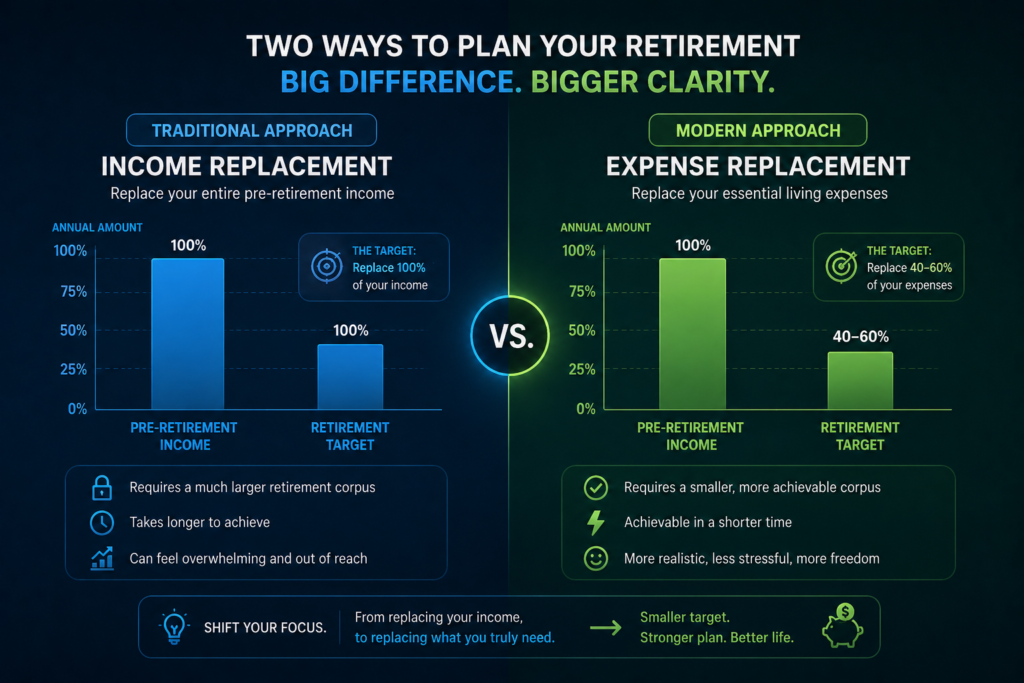
What finally made this click for me was shifting my focus away from my income and entirely toward my expenses.
Your retirement accounts don’t care what your gross salary was at age 45. They only care how much money you need to withdraw every month to buy groceries, pay the electric bill, and go on vacation.
If you make $150,000 a year but you aggressively save and only actually spend $60,000 a year to live a life you love, you don’t need to replace a $150,000 lifestyle. You only need to replace a $60,000 lifestyle.
Instead of obsessing over age-based multiples, I prefer looking at the gap between what I will spend in retirement and what guaranteed income I will have.
If you expect to spend $80,000 a year in retirement, and you expect Social Security to pay you $30,000 a year, you only have a $50,000 gap to fill. From there, you can use frameworks like the 25x rule—multiplying your $50,000 gap by 25 to find a target portfolio size of roughly $1.25 million.
This isn’t tied to your current age or your current salary. It is tied strictly to your actual, real-world lifestyle.
The Real Catch-Up Plan (If You Are Actually Behind)
Even after adjusting your expectations based on expenses, you might still look at your accounts and realize you need to step on the gas.
I have been there. The realization can be uncomfortable, but the worst thing you can do is freeze. The tax code is actually designed to help you rapidly accelerate your savings later in your career.
For 2026, the IRS has rolled out some incredibly powerful rules for older workers. If you are behind, here is exactly how the 2026 catch-up limits work and how you should use them.
The Standard 50+ Catch-Up
Once you turn 50, the IRS allows you to aggressively pad your retirement accounts.
In 2026, the standard employee limit for a 401(k), 403(b), or TSP is $24,500. But if you are 50 to 59 years old (or 64 and older), you get an $8,000 standard catch-up allowance. This means you can funnel up to $32,500 of your own money into your workplace plan this year.
If you also utilize an IRA, the standard limit is $7,500, but being over 50 gives you an extra $1,100 catch-up, allowing a total of $8,600.
The New 2026 “Super” Catch-Up for Ages 60-63
This is one of the most important changes for 2026, and a lot of people aren’t aware of it yet.
If you are exactly in the window of ages 60, 61, 62, or 63, the government is giving you a massive, temporary “super” catch-up allowance for your workplace plan. Instead of the standard $8,000 catch-up, you can contribute an extra $11,250.
Added to the base limit of $24,500, this means a 60-to-63-year-old can stash $35,750 into their 401(k) in 2026. If you combine that with a maximum employer match, you are pushing staggering amounts of money into the market during your peak earning years.
I personally look at this four-year window as the ultimate sprint. If you are behind in your late fifties, this is the exact tool you use to close the gap before you retire.
The New Roth Catch-Up Mandate for High Earners
There is a major catch in 2026 that you must be aware of if you have a high income.
Starting in 2026, if you earned more than $150,000 in FICA wages in the prior year from your employer, you are no longer allowed to make your catch-up contributions on a pre-tax (traditional) basis. All of your catch-up contributions must be directed into a Roth account.
This means you will pay taxes on that money now, but it will grow and be withdrawn tax-free in retirement.
I’ve spoken to several investors who were caught off guard by this. If your employer’s plan doesn’t offer a Roth 401(k) option yet, you actually cannot make catch-up contributions at all until they update their plan to comply with the new law. If you make over $150,000, you need to check your HR portal immediately to ensure your Roth options are active.
My Checklist: What to Do When You Feel Behind
Understanding the limits is one thing, but actually finding the cash to invest is another. When I realized I was behind the curve in my early thirties, I didn’t suddenly invent more money. I had to change my behavior.
If you are trying to catch up, here is the exact checklist I recommend.
1. Automate your increases, not just your contributions. Don’t just set your 401(k) contribution to 6% and forget about it. Log into your provider and find the “auto-increase” feature. Set it to increase your contribution by 1% or 2% every single January. You will barely feel the reduction in your paycheck, but over five years, you will quietly transform yourself into an aggressive saver.
2. Stop upgrading your lifestyle with your raises. This is the single biggest trap I see. When people get a $5,000 raise, they finance a better car or rent a nicer apartment. If you are behind on retirement, every single raise or bonus should be viewed strictly as catch-up capital. Funnel 100% of your next pay bump directly into your investments before it ever hits your checking account.
3. Maximize the HSA. If you have a High Deductible Health Plan, the Health Savings Account (HSA) is your secret weapon. For 2026, a family can put $8,750 into an HSA ($4,400 for individuals), plus a $1,000 catch-up if you are 55 or older. This money is pre-tax going in, grows tax-free, and comes out tax-free for medical expenses. I personally view my HSA as a secondary retirement account, aggressively funding it to ensure my future healthcare costs don’t drain my traditional portfolio.
4. Re-evaluate your retirement vision. If the math truly isn’t working, you have to change the variables. This doesn’t mean eating cat food in retirement. It might mean transitioning to part-time consulting at age 65 instead of a hard stop. It might mean relocating to a state with zero income tax and lower property costs. Flexibility is just as valuable as capital.
Final Thoughts
The next time you see an article proclaiming you need three times your salary by age 40, take a deep breath.
Those benchmarks are written for a perfectly average, theoretical person who doesn’t actually exist. They don’t know your history, they don’t know your debts, and they don’t know your specific retirement goals.
Measure your progress against your own spending habits. Take advantage of the massive 2026 catch-up provisions if you need them. And most importantly, remember that personal finance is exactly that… personal. Your timeline is the only one that matters.





No Comment! Be the first one.