

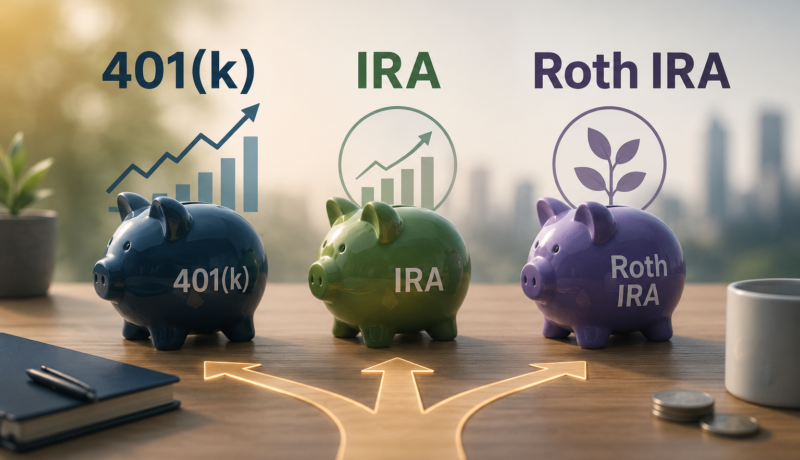

I still remember staring at my first HR onboarding packet, completely paralyzed by the retirement section.
Table Of Content
- The Only Difference That Actually Matters
- The Traditional Route (Pay Later)
- The Roth Route (Pay Now)
- The 2026 Rulebook: Limits and Boundaries
- The Exact 2026 Stacking Order
- Step 1: The Employer Match (Free Money)
- Step 2: The Health Savings Account (HSA)
- Step 3: Max Out the Roth IRA
- Step 4: Go Back and Max the 401(k)
- Step 5: The Taxable Brokerage
- What Changes for High Earners?
- Two Massive Mistakes to Avoid
- My Personal Approach
There were checkboxes for a Traditional 401(k), a Roth 401(k), and a bunch of mutual funds I couldn’t even pronounce. On top of that, my financially savvy friends were telling me I needed a Roth IRA, and some articles online were screaming about Health Savings Accounts.
I had a limited amount of money to save out of each paycheck, and absolutely no idea where the first dollar should go, let alone the thousandth.
If you are feeling that exact same paralysis right now, take a breath. You are not alone.
The financial industry loves to overcomplicate retirement accounts. They throw around acronyms and tax codes until you get so frustrated you just pick a random percentage and hope for the best. But when you strip away the jargon, these accounts are just different types of buckets. Your goal is simply to fill the right buckets, in the right order, to keep the most money away from the IRS.
Here is exactly how I look at these accounts today, the rules for 2026, and the exact step-by-step priority order I use to fund them.
The Only Difference That Actually Matters
Before we rank the accounts, we need to understand what makes them different.
At their core, a 401(k) and an IRA do the exact same thing: they hold your investments. They are not investments themselves. Think of them like a shopping cart. The cart doesn’t make you money; the groceries (stocks, bonds, index funds) you put inside the cart make you money. The account just protects those investments from taxes while they grow.
The only real difference between these accounts is when you pay the taxes.
The Traditional Route (Pay Later)
If an account has the word “Traditional” in front of it—like a Traditional 401(k) or a Traditional IRA—it means you are taking a tax break right now.
If you earn $80,000 this year and put $10,000 into a Traditional 401(k), the IRS pretends you only earned $70,000. You pay less tax today. Your money grows untouched for decades. But there is a catch. When you are 65 and want to pull that money out to buy groceries or take a vacation, the IRS steps in and taxes every dollar you withdraw as regular income.
The Roth Route (Pay Now)
If an account has the word “Roth” in front of it, the deal is reversed.
You pay your income taxes up front, exactly like you do on your normal paycheck. You take that after-tax money and put it into a Roth IRA or Roth 401(k). Because you already paid the toll, the money grows completely tax-free forever. When you pull it out in retirement, you owe the IRS absolutely nothing.
I like to think of it like farming. Do you want to pay taxes on the tiny seeds you plant today (Roth), or do you want to pay taxes on the massive harvest you reap thirty years from now (Traditional)? For most younger investors, or anyone who thinks tax rates will go up in the future, the Roth is incredibly powerful.
The 2026 Rulebook: Limits and Boundaries
To play the game, you have to know the limits. Every year, the IRS adjusts how much we are allowed to put into these tax-sheltered buckets.
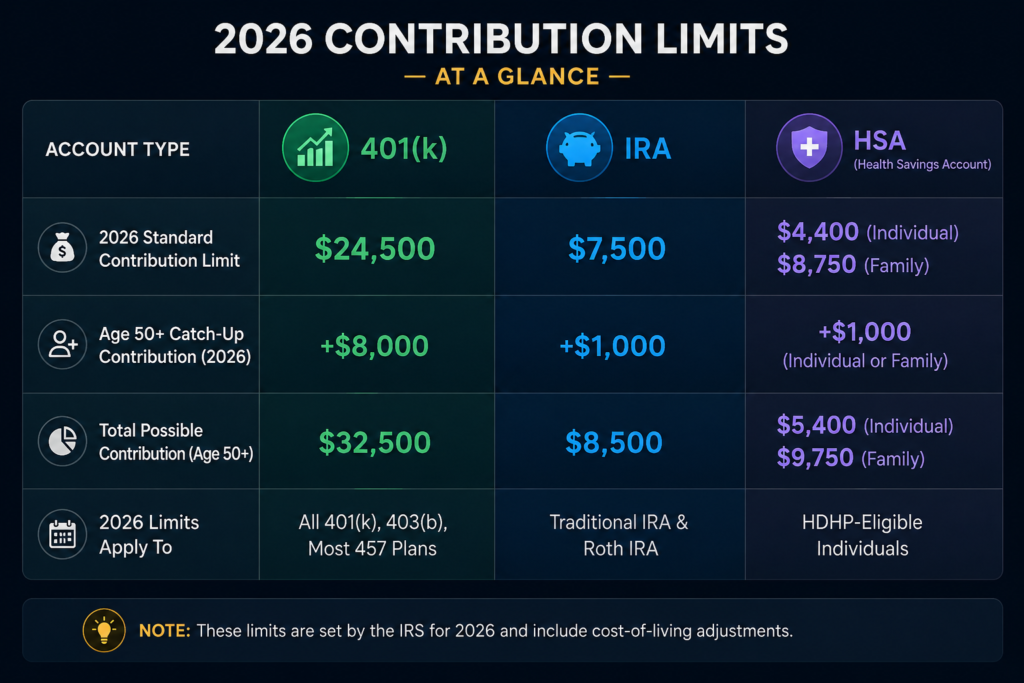
For 2026, the numbers have shifted slightly from last year:
The 401(k) Limits: Your 401(k) is the account sponsored by your employer. The huge advantage here is the sheer amount of money you can shelter. In 2026, you can defer up to $24,500 of your own salary into a 401(k).
If you are 50 or older, you get an $8,000 “catch-up” allowance. And if you fall into the very specific window of being 60 to 63 years old this year, you get a special “super” catch-up of $11,250. Keep in mind, if you are a high earner (making over $150,000 in prior-year FICA wages), a brand new rule in 2026 dictates that your catch-up contributions must be made as Roth contributions.
The IRA Limits: An IRA (Individual Retirement Account) is an account you open entirely on your own at a brokerage like Fidelity, Vanguard, or Schwab. It has nothing to do with your boss.
Because you have total control over it, the IRS keeps the limits much tighter. In 2026, you can only contribute $7,500 across your IRAs for the year (plus an extra $1,100 if you are 50 or older).
The Income Trap: Here is where people make painful mistakes. Anyone with earned income can put money into a Traditional IRA. But if you also have a 401(k) at work, you only get the tax deduction if your income is below a certain threshold (phasing out between $81,000 and $91,000 for single filers in 2026).
Roth IRAs have strict income limits too. If you are single and your Modified Adjusted Gross Income hits $153,000 (or $242,000 if married filing jointly), the front door to a Roth IRA starts slamming shut. You’ll have to use more advanced strategies to get your money in.
The Exact 2026 Stacking Order
When I first started investing, I thought I was supposed to max out my 401(k) entirely before looking at anything else. I was wrong.
By dumping everything into my employer’s plan, I was trapped in their high-fee mutual funds and missing out on the incredible tax flexibility of a Roth IRA.
Over the years, financial planners have universally adopted a specific “order of operations.” This is the step-by-step stacking order for where your money should go. You do not move to the next step until the current step is full (or until you run out of money to invest for the month).
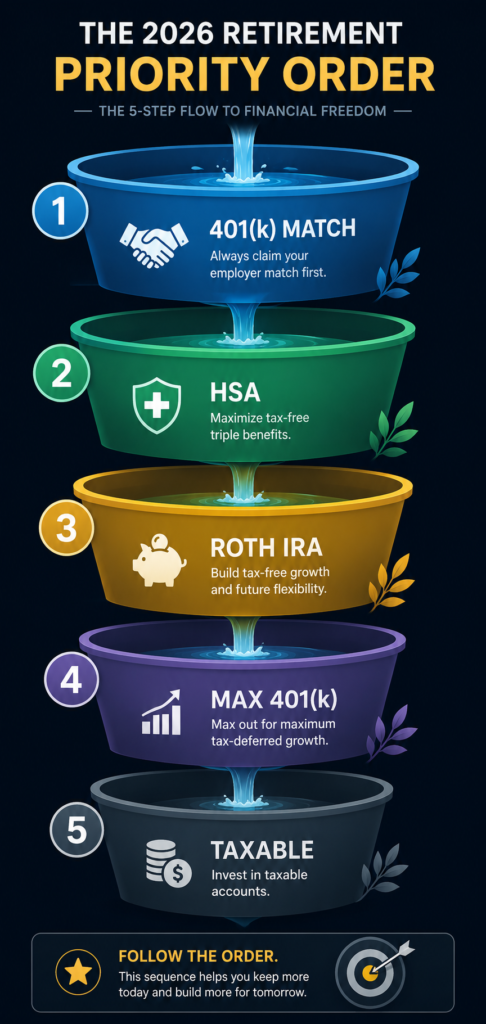
Step 1: The Employer Match (Free Money)
Your very first priority, without exception, is to contribute enough to your 401(k) to get every single dollar your employer is willing to match.
If your company offers a 100% match on the first 5% of your salary, and you make $100,000, they are offering you $5,000. If you do not contribute that 5%, you are literally taking a $5,000 pay cut. I don’t care if the funds in your 401(k) are terrible. There is no investment on earth that gives you a guaranteed, immediate 100% return on your money. Get the match, and then stop.
Step 2: The Health Savings Account (HSA)
This might sound strange in a retirement article, but if you have a High Deductible Health Plan (HDHP) at work, you have access to an HSA. I personally treat my HSA as my favorite stealth retirement account.
Why? Because it boasts a “triple tax advantage” that neither a 401(k) nor an IRA can touch. The money goes in tax-free, it grows tax-free, and if you use it for medical expenses, it comes out tax-free.
For 2026, you can put $4,400 into an HSA as a single person, or $8,750 for a family. My strategy is simple: I max this out, invest the cash in index funds inside the HSA, and pay for my minor medical bills out of my normal checking account. I save the receipts. Decades from now, I can reimburse myself completely tax-free, allowing that money to compound in the background for years.
Step 3: Max Out the Roth IRA
Once you have your free employer match and your HSA funded, do not put your next dollar into the 401(k). Pivot to a Roth IRA.
Why switch? Because your 401(k) gives you a tiny menu of investments chosen by your HR department, often with hidden administrative fees. A Roth IRA gives you total freedom. You can open it at Vanguard or Schwab, buy rock-bottom fee total market index funds, and pay almost zero expenses.
Furthermore, Roth IRAs give you a unique safety net. Because you already paid taxes on the money you put in (the contributions), you can withdraw those exact contributions at any time, for any reason, without taxes or penalties. I don’t recommend treating your retirement account like an ATM, but knowing that flexibility exists brings massive peace of mind.
Your goal here is to fill up the $7,500 limit for 2026.
Step 4: Go Back and Max the 401(k)
If you still have money left to invest at the end of the month after hitting your match, filling the HSA, and maxing the Roth IRA, congratulations—you are a super-saver.
Now, you go back to your HR portal and bump up your 401(k) contributions. Your goal is to try and hit that massive $24,500 limit. At this stage, you are shielding a serious amount of your income from taxes, accelerating your path to financial independence.
Step 5: The Taxable Brokerage
If you have completely filled every tax-advantaged bucket the IRS allows, your final stop is a standard taxable brokerage account. There are no contribution limits here, no age restrictions on when you can pull the money out, and no complicated rules. You will pay capital gains taxes on your profits, but it provides ultimate liquidity if you plan to retire early.
What Changes for High Earners?
If your career is taking off, you will eventually hit a wall with Step 3.
As I mentioned earlier, in 2026, the IRS cuts off your ability to contribute directly to a Roth IRA if your single income crosses $168,000 (or $252,000 for married couples).
When you hit this phase-out, you don’t skip Step 3; you just have to take a detour. You execute something called a Backdoor Roth IRA. This involves putting your $7,500 into a non-deductible Traditional IRA (which has no income limits) and immediately converting it to a Roth IRA. It requires an extra tax form at the end of the year, but it completely bypasses the income restriction.
If you are self-employed with high income, your priorities shift slightly too. You won’t have a corporate 401(k) match, but you can open a Solo 401(k) or a SEP IRA, which allows you to shelter up to $72,000 in 2026 depending on your business revenue.
Two Massive Mistakes to Avoid
In my years of talking to people about their portfolios, I see two painful mistakes happen constantly when navigating these accounts.
Mistake #1: The Cash Trap. An alarming number of people open a Roth IRA, transfer $7,500 from their bank, and then do nothing. They think “putting money in the IRA” is the investment. It isn’t. The money just sits in a settlement fund earning minimal interest. Once the money is in the account, you have to log back in and explicitly buy an index fund or a target-date fund.
Mistake #2: The All-Pre-Tax Retirement. If you do nothing but max out a Traditional 401(k) for thirty years, you will have a massive balance when you retire. But every single dollar you withdraw will be taxed as ordinary income. If you want to buy a $40,000 car in retirement, you might have to withdraw $55,000 just to cover the taxes. Having a mix of Traditional money and Roth money gives you control over your tax bracket when you stop working.
My Personal Approach
At the end of the day, the best retirement strategy is the one you actually stick to.
I know that if I have to manually transfer money every month, I will find an excuse to spend it instead. So I automate the priority order.
My 401(k) match is pulled from my paycheck before I ever see it. My HSA contribution is deducted automatically. I have an automatic transfer set up on the 1st of every month to move $625 from my checking account to my Roth IRA (which equals exactly $7,500 over 12 months).
Once the system is built, you never have to think about it again. You just let the market do the heavy lifting while you get back to living your life.
Start with Step 1 today. Log into your payroll provider and make sure you aren’t leaving free money on the table. Once that’s done, you can start building your buckets.





No Comment! Be the first one.