
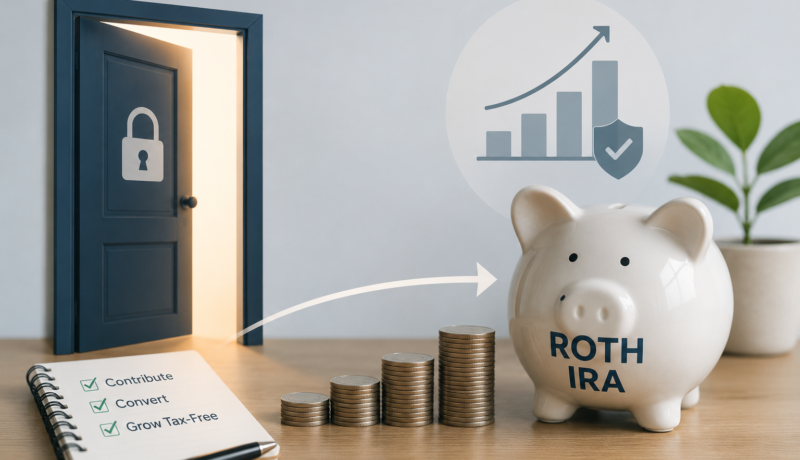
I remember the exact year my accountant told me I couldn’t contribute to my Roth IRA anymore. I had just landed a solid promotion, feeling great about my financial trajectory, and I was fully prepared to max out my Roth on January 1st like I always did.
Table Of Content
- The Pro-Rata Trap (Read This Before Doing Anything)
- The 2026 Income Limits: Why You Need the Backdoor
- Step-by-Step: How to Execute a Backdoor Roth IRA
- Step 1: Open the Right Accounts
- Step 2: Fund the Traditional IRA
- Step 3: Wait for the Funds to Settle
- Step 4: Convert to the Roth IRA
- Step 5: Invest the Money
- The Most Critical Tax Form: IRS Form 8606
- The Mega Backdoor Roth: The Advanced Move
- Final Thoughts on the Backdoor Strategy
Then came the reality check: I made too much money.
The IRS has strict income limits on who can put money directly into a Roth IRA. If you earn over a certain amount, the front door is locked. When I first started investing, I thought that was the end of the story. I assumed Roth IRAs were just a tool for early-career professionals and that I had simply aged out of the benefit.
I was completely wrong.
What I didn’t know at the time was that while the front door might be locked to high earners, the back door is wide open. It’s a perfectly legal, well-documented tax maneuver known as the Backdoor Roth IRA. I use it every single year, and if your income has pushed you past the standard limits, you should probably be using it too.
But before we get into the step-by-step mechanics of how I execute this in my own portfolio, we need to talk about a massive landmine hidden in the tax code that blows this strategy up for thousands of investors every year.
The Pro-Rata Trap (Read This Before Doing Anything)
Most guides bury this warning at the very bottom, but I’ve learned that this is the absolute most important part of the Backdoor Roth strategy. If you skip this, you could end up with a surprise tax bill that wipes out the benefits of doing this in the first place.
It’s called the pro-rata rule.
Here is exactly how I look at it. To do a Backdoor Roth, you are going to put after-tax money into a Traditional IRA, and then immediately convert it to a Roth IRA. Since you already paid taxes on that money from your paycheck, moving it to the Roth should be a tax-free event.
However, the IRS looks at all of your Traditional IRAs as one giant bucket. They do not care if you have an empty Traditional IRA at Vanguard for this backdoor move, and a $100,000 Rollover IRA at Fidelity from an old job. To the IRS, it’s all just one big IRA.
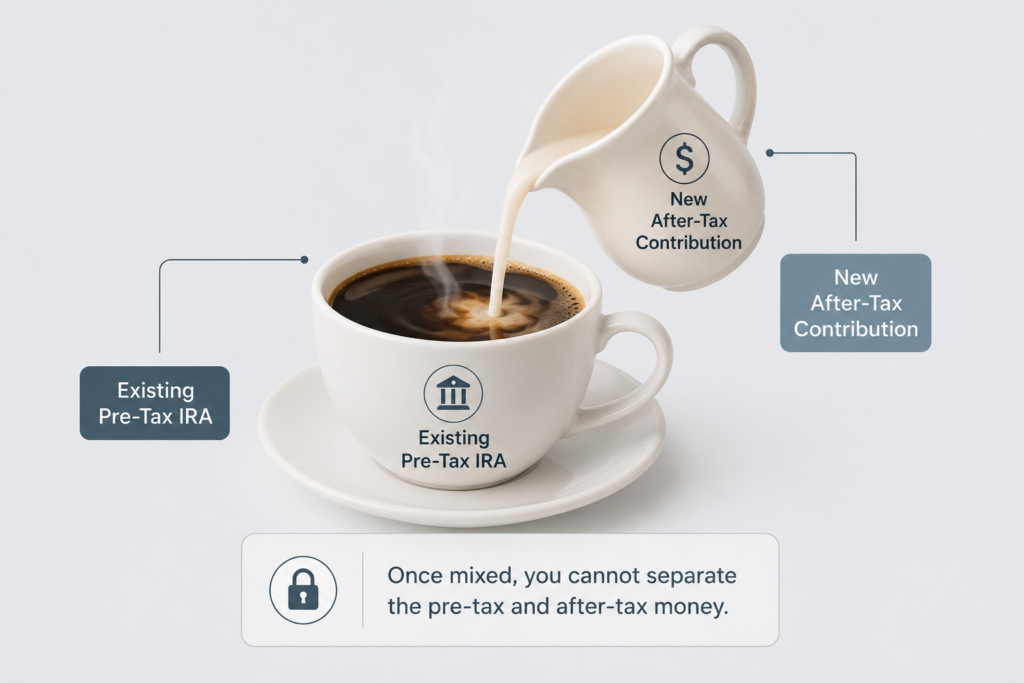
What finally made this click for me was the coffee analogy. Think of your existing pre-tax IRA money as black coffee, and your new after-tax contribution as cream. Once you pour the cream into the coffee, you can’t scoop just the cream back out. It’s permanently mixed.
If you try to convert just your new $7,500 after-tax contribution to a Roth, the IRS will look at the total percentage of pre-tax vs. after-tax money across all your IRAs. If 90% of your total IRA balance is pre-tax from old 401(k) rollovers, then 90% of your conversion will be taxed as ordinary income.
I personally avoid this entirely by ensuring I have exactly $0 in any Traditional, Rollover, SEP, or SIMPLE IRAs before December 31st of the year I do the conversion.
If you have existing pre-tax IRAs, you have a few options to clear the deck:
- Roll that pre-tax IRA money into your current employer’s 401(k), if the plan allows it. (This is what I did to hide my pre-tax money from the pro-rata calculation).
- Convert the entire existing balance to a Roth IRA and pay the tax on it now. (Only makes sense if the balance is very small).
- Skip the Backdoor Roth entirely.
If your Traditional IRA balances are completely zeroed out, you are clear to proceed.
The 2026 Income Limits: Why You Need the Backdoor
Let’s briefly touch on why you actually have to do this. For 2026, the IRS raised the contribution limits and the income phase-outs.
You can contribute $7,500 to an IRA this year (or $8,600 if you are 50 or older).
But your ability to put that money directly into a Roth IRA starts getting reduced—and eventually eliminated—based on your Modified Adjusted Gross Income (MAGI).
If you are filing as Single, the phase-out starts at $153,000. If you make over $168,000, you are completely locked out of direct contributions.
If you are Married Filing Jointly, the phase-out starts at $242,000 and hard-stops at $252,000.
If your household income is above those upper limits, the Backdoor Roth is your only path in.
Step-by-Step: How to Execute a Backdoor Roth IRA
When I execute this for my own household, it takes me about ten minutes of actual clicking. The first time you do it, it feels intimidating because you don’t want to make a mistake with the IRS. But once you understand the mechanics, it’s incredibly straightforward.
Here is my exact step-by-step process.
Step 1: Open the Right Accounts
You need two accounts at the same brokerage: a Traditional IRA and a Roth IRA. I keep mine at the same institution (like Schwab, Fidelity, or Vanguard) because transferring money between two accounts under the same roof is instant and doesn’t trigger any weird holding periods.
If you don’t have these open yet, go ahead and open both. You don’t need to fund them during the setup process.
Step 2: Fund the Traditional IRA
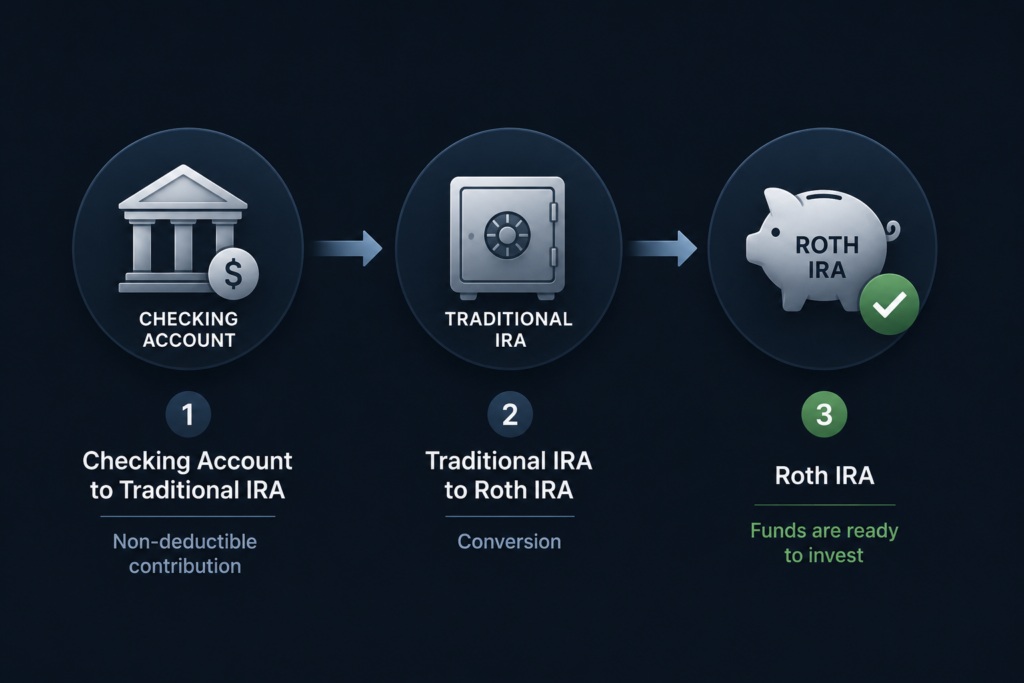
Next, I transfer cash from my normal checking account into the Traditional IRA. For 2026, I move the full $7,500 in one lump sum.
When you do this, you are making a non-deductible contribution. This just means you aren’t going to claim a tax deduction for this $7,500 when you file your taxes next spring. You are using money that has already been taxed by your employer.
Leave this money in cash. Do not buy stocks, do not buy index funds. Just let the cash settle in a money market or settlement fund.
Step 3: Wait for the Funds to Settle
This is a minor mechanical step, but it trips people up. Depending on your brokerage, it can take a few days for the bank transfer to fully clear. During this time, the brokerage might show the money in your account, but won’t let you transfer it out.
I usually just set a calendar reminder for 3 to 5 business days after I make the deposit.
Step 4: Convert to the Roth IRA
Once the cash has settled, log back into your brokerage. Look for a button that says “Transfer,” “Convert,” or “Move Money.”
You are going to initiate a transfer of the entire $7,500 balance from your Traditional IRA into your Roth IRA. The brokerage will usually pop up a terrifying warning asking if you want them to withhold taxes for this conversion.
I always check “No” or “Do not withhold taxes.”
Why? Because I am converting after-tax money. I didn’t take a deduction on it, so I don’t owe tax on the conversion. (Again, this assumes you listened to my warning about the pro-rata rule and have no other pre-tax IRAs).
Hit submit. The Traditional IRA goes down to $0, and the Roth IRA goes up by $7,500.
Step 5: Invest the Money
Now that the money is safely resting inside the Roth IRA, the backdoor maneuver is technically complete. But I’ve seen people do all of this work and leave the money sitting in cash for years.
Don’t forget to actually buy your investments. Log into the Roth, take that $7,500 cash balance, and deploy it into your preferred index funds or ETFs so it can start growing tax-free.
The Most Critical Tax Form: IRS Form 8606
I’ve made this mistake before, and it was incredibly annoying to fix. When tax time rolls around the following spring, you absolutely must tell the IRS what you did.
Your brokerage is going to send you a 1099-R showing a $7,500 distribution from your Traditional IRA. If you just hand that to a basic tax software without context, the software will assume you owe income tax on that $7,500.
To prevent this, you have to file IRS Form 8606.
This form simply tells the government: “Hey, I put $7,500 of already-taxed money into a Traditional IRA, and then I moved it to a Roth. Please don’t tax me twice.”
If you use a CPA, just tell them you did a Backdoor Roth and they will handle it. If you use TurboTax or FreeTaxUSA, you have to carefully answer the prompts about non-deductible IRA contributions and conversions. The software will generate Form 8606 for you automatically, but you have to make sure you check the right boxes to let it know the initial contribution was not deducted from your income.
The Mega Backdoor Roth: The Advanced Move
If you have already maxed out your $24,500 401(k) limit and you’ve done the standard $7,500 Backdoor Roth, you might think you are out of tax-advantaged space.
But there is a level beyond this. In my own portfolio, this is the holy grail of retirement savings. It’s called the Mega Backdoor Roth, and it allows high earners to stuff up to tens of thousands of extra dollars into a Roth account every single year.
In 2026, the IRS combined limit for all 401(k) contributions (your deferrals plus your employer’s match) is $72,000.
Most people never hit this. If you max out your $24,500 employee limit, and your employer gives you a $5,000 match, your total is $29,500. That leaves $42,500 of unused 401(k) space.
The Mega Backdoor Roth allows you to fill that remaining space with your own money.
Here is how it works: Some employer 401(k) plans allow you to make “after-tax non-Roth” contributions above the standard $24,500 limit. If your plan allows this, you can contribute extra money from your paycheck into this after-tax bucket.
Then, if your plan allows “in-service distributions” or “in-plan Roth conversions,” you can immediately sweep those after-tax dollars directly into a Roth 401(k) or out to your personal Roth IRA.
This strategy is highly plan-dependent. I’ve had jobs where the 401(k) plan allowed it, and jobs where they didn’t. You can’t just do this on your own; your company’s 401(k) document has to explicitly support after-tax contributions and in-service conversions.
If you aren’t sure, call your 401(k) provider (like Fidelity or Vanguard) and ask them two specific questions:
- “Does my plan allow for after-tax contributions beyond the standard deferral limit?”
- “Does my plan allow for automated in-plan Roth conversions or in-service withdrawals of those after-tax funds?”
If they say yes to both, you just unlocked the ability to turbocharge your tax-free growth.
Final Thoughts on the Backdoor Strategy
When you lay it all out, the Backdoor Roth IRA sounds like a loophole that someone is eventually going to close. But Congress has actually formally recognized this strategy in recent years, making it a legitimate, mainstream way for high-income earners to build tax-free wealth.
I’ve learned that the hardest part isn’t the tax code or the IRS forms—it’s just getting over the mental hurdle of doing it the first time.
Keep your Traditional IRA balances at zero to avoid the pro-rata trap, make your non-deductible contribution, convert it to Roth, and make sure Form 8606 gets filed at tax time. It’s a few extra clicks once a year that can secure decades of tax-free growth for your future.





No Comment! Be the first one.