
A few years ago, I was looking at my traditional IRA balance and feeling pretty good about myself. The compounding was doing its job, the balance was growing, and I felt like I was winning the retirement game.
Table Of Content
Then a tax-savvy friend of mine sat me down, looked at my numbers, and ruined my afternoon.
He pointed out that the large, impressive number staring back at me from the screen wasn’t actually all mine. A huge chunk of it belonged to the IRS. Because I had used traditional, pre-tax accounts for most of my career, I had never paid taxes on that money. And eventually, the government was going to come collecting.
That realization changed how I invest. It’s what introduced me to the Roth conversion strategy, and more specifically, the Roth conversion ladder.
If you have a large balance in a traditional 401(k) or traditional IRA, you are essentially sitting in a tax partnership with the government. You don’t know what tax brackets will be in the future, meaning you don’t know the government’s exact cut. A Roth conversion is how you buy out your partner.
But doing it at the wrong time can cost you tens of thousands of dollars. Here is exactly how I look at the Roth conversion trade-off, the golden window of when to do it, and the mistakes I personally avoid.
The Core Trade-Off: Paying Taxes on Purpose
When you introduce a complex financial concept, it helps to strip away the jargon.
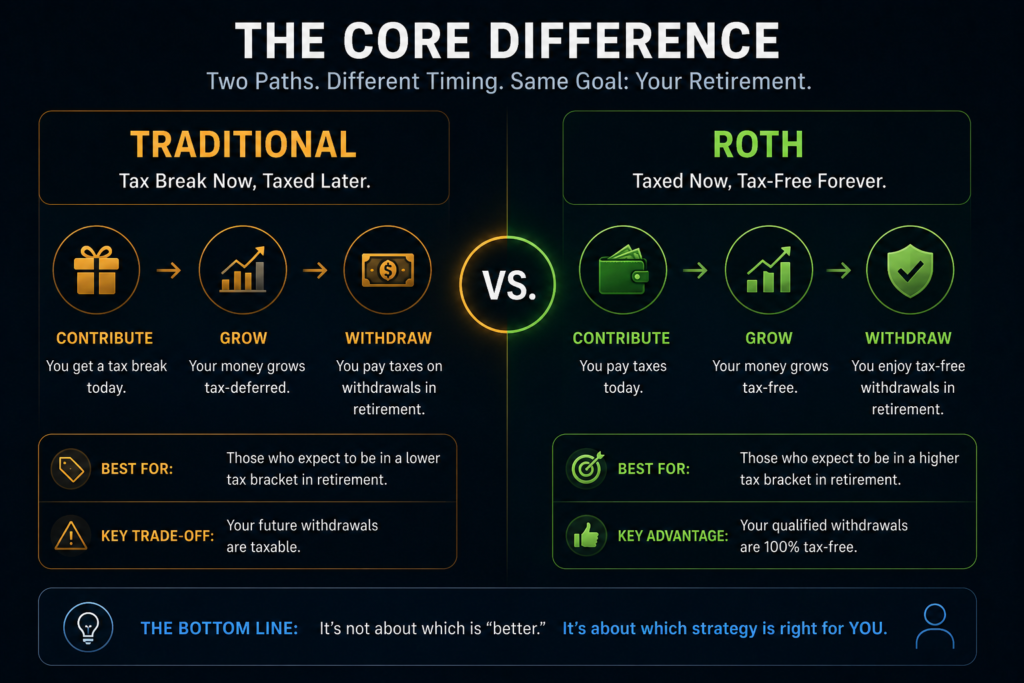
A Roth conversion is incredibly simple at its core. You take money from your traditional, pre-tax retirement account, and you move it into a Roth, post-tax retirement account.
Because you never paid taxes on that traditional money, the IRS makes you pay income tax on whatever amount you convert in the year you convert it.
Why on earth would you volunteer to pay taxes right now?
Because once that money is in the Roth account, it grows tax-free forever. More importantly, when you pull it out in retirement, you pay zero taxes. You are trading a known tax hit today for tax-free growth and tax-free spending tomorrow.
What finally made this click for me was realizing that retirement planning isn’t just about how much money you have. It is about how much money you actually get to keep. Having control over my tax bill in retirement is a superpower. If all my money is in a traditional IRA, every dollar I withdraw raises my taxable income. If a chunk of my money is in a Roth IRA, I can pull from it without moving the needle on my tax return at all.
What is a Roth Conversion Ladder?
A Roth conversion ladder is a strategy used heavily by early retirees to access their retirement funds long before the standard age of 59½ without paying early withdrawal penalties.
Here is how it works in plain English.
Normally, if you pull money out of a traditional IRA before you turn 59½, the IRS hits you with income tax plus a brutal 10% early withdrawal penalty. But there is a loophole. When you convert money from a traditional IRA to a Roth IRA, you pay the income taxes, but you do not pay the 10% penalty.
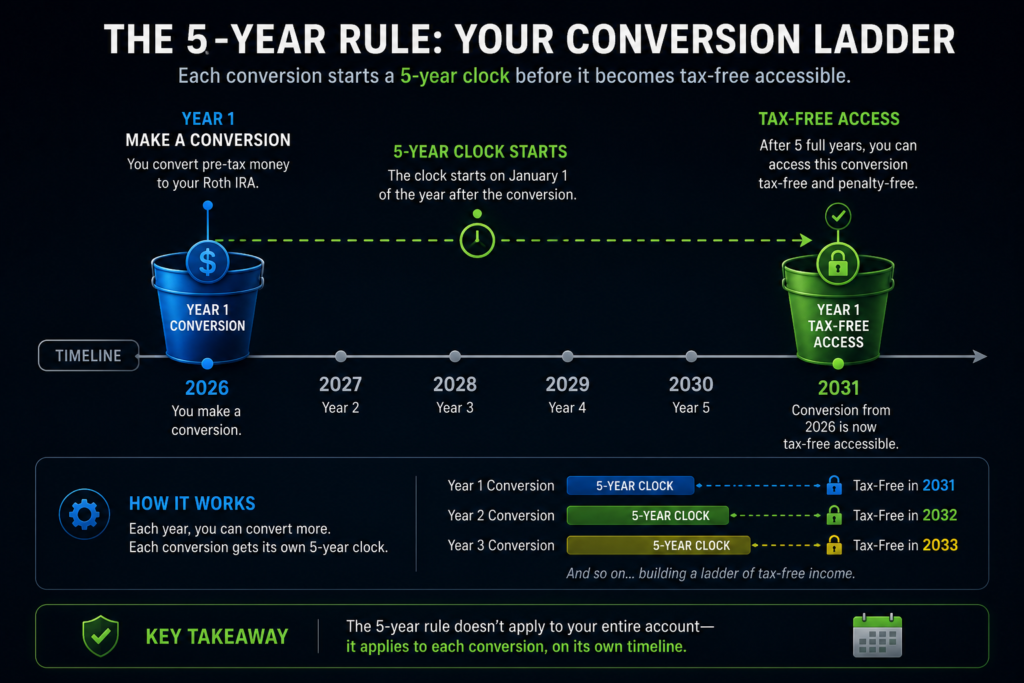
Once that money lands in your Roth IRA, a clock starts ticking. After exactly five years, the IRS allows you to withdraw that converted principal amount absolutely penalty-free, no matter how old you are.
So, if you want to retire at 50, you can’t just pull money out of your traditional IRA to pay for groceries. But what you can do is convert, say, $50,000 from your traditional IRA to your Roth IRA when you are 45. You pay the taxes on it that year. Five years later, at age 50, you withdraw that $50,000 completely tax-free and penalty-free to live on.
If you convert a set amount of money every single year, you create a “ladder.” By the time you retire, you have a rolling five-year pipeline of tax-free money becoming available to you every single year.
The Catch: Understanding the 5-Year Rule
This is the part that trips up almost everyone, and it is a mistake I see frequently.
The 5-year rule for Roth conversions is strict. Every single conversion has its own distinct five-year clock.
If you convert $30,000 in 2026, that specific $30,000 is locked up from penalties until January 1, 2031. If you convert another $30,000 in 2027, that specific batch is locked up until January 1, 2032.
You cannot convert money today and spend it penalty-free tomorrow just because you want to retire early. The ladder takes five years to build before you can take your first step on it. You need a separate bucket of money usually a taxable brokerage account or cash savings to live on during those first five years while you wait for your first conversion to age out.
The Golden Window: When Converting Makes the Most Sense
You should not just blindly convert money to a Roth every year. If you are in your peak earning years, in a high tax bracket, converting money is usually a terrible idea. You are volunteering to pay taxes at the highest possible rate.
Instead, you want to convert money during what I call “low-income windows.”
This is exactly what I plan for in my own portfolio. A low-income window is a year where your taxable income drops significantly. Because the US tax system is progressive, a drop in income means you drop down into lower tax brackets.
Here is when these windows typically open:
The Early Retirement Gap If you retire at 55, you no longer have a salary. You also aren’t old enough to collect Social Security, and you aren’t forced to take money out of your retirement accounts yet. For tax purposes, you might look practically broke. This is the absolute best time to do Roth conversions. You can convert tens of thousands of dollars and pay taxes on it at the lowest 10% or 12% brackets.
Career Breaks or Sabbaticals If you take a year off work, go back to school, or start a business that doesn’t turn a profit immediately, your income drops. I know several investors who used a layoff not just to hunt for a new job, but as an opportunity to convert pre-tax money at a massive discount.
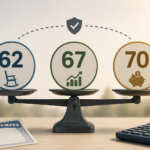
Before Social Security Starts Even if you retire at a traditional age, there is usually a gap between when you stop working and when you claim Social Security (often delayed until age 70 for maximum benefit). Those gap years are a prime window for conversions.
The strategy here is to “fill up the bracket.” You look at the current tax brackets, see how much room you have left in the low brackets before your income spills over into the high ones, and you convert exactly that amount of money.
Defusing the RMD Tax Bomb
There is another massive reason to consider conversions, even if you don’t plan on retiring early. It has to do with forced withdrawals later in life.
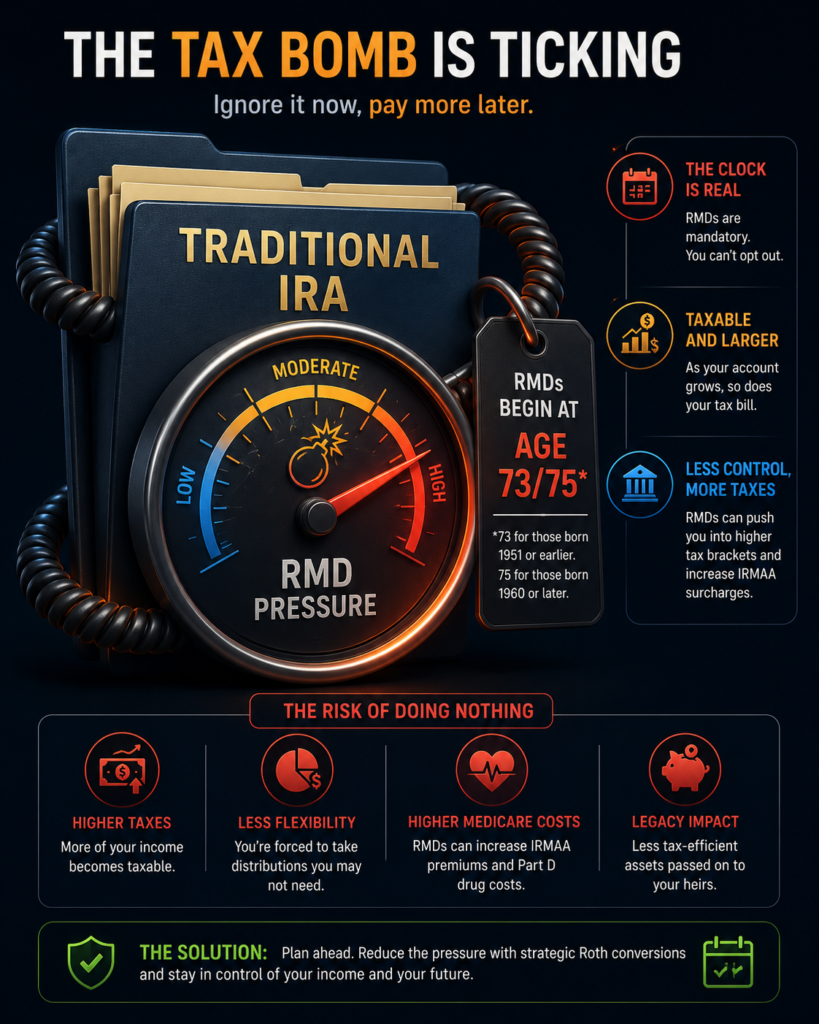
The IRS doesn’t let you keep money in a traditional IRA forever. Starting in your 70s, the government forces you to pull a specific percentage of that money out every single year and pay taxes on it. These are called Required Minimum Distributions (RMDs).
If you have been a diligent saver and have a couple of million dollars sitting in pre-tax accounts, your RMDs can be shockingly high. I’ve seen retirees forced to withdraw $80,000 or $100,000 a year, pushing them into brutal tax brackets and drastically increasing the cost of their Medicare premiums.
This is the RMD tax bomb.
Roth accounts, however, do not have RMDs. If your money is in a Roth IRA, you can leave it there until you die if you want to. By strategically converting your traditional money to Roth money during your 50s and 60s, you actively shrink your traditional IRA balance. A smaller traditional balance means smaller RMDs later, saving you from a massive, forced tax bill when you are in your 70s and 80s.
When I Personally Avoid Conversions
As powerful as this strategy is, it isn’t for everyone. I’ve learned that forcing a conversion in the wrong scenario just destroys wealth. Here is when I would absolutely advise against it.
When you have to pay the taxes from the IRA itself. When you do a conversion, you owe taxes. The absolute best way to pay those taxes is with cash from a separate checking or savings account. If you have to withhold taxes from the conversion amount itself, you are permanently removing that money from the market, losing all future compounding, and possibly getting hit with an early withdrawal penalty on the withheld amount. If I don’t have the cash on hand to pay the tax bill, I don’t do the conversion.
During peak earning years. If you are currently making $200,000 a year, any money you convert is going to be taxed at a very high marginal rate. It is almost always better to wait for retirement, when your income naturally drops, to do your conversions.
If you plan to move to a lower-tax state. Let’s say you currently live and work in California, where state income taxes are notoriously high. If you plan to retire in Nevada or Florida, where there is no state income tax, do not convert your money while you still live in California. You would be voluntarily paying California state tax on money you could convert tax-free at the state level a few years later.
Putting It All Together
A Roth conversion ladder isn’t just a math trick; it is a mindset shift. It requires you to stop looking at your retirement accounts as a final destination, and start looking at them as moving pieces on a chessboard.
You are taking the timeline the IRS set for you—age 59½ for penalty-free access, and age 73 for forced withdrawals and rewriting it on your own terms.
It stings to write a check to the IRS today. I won’t pretend it doesn’t. But every time I convert funds during a low-income year, I remind myself that I am buying freedom. I am buying the ability to pull money out in my 60s without worrying about tax brackets. I am buying the ability to leave tax-free money to my kids.
Taxes are inevitable, but exactly when and how much you pay is surprisingly up to you.


No Comment! Be the first one.