



When I first started putting money into a 401(k) years ago, I thought “maxing it out” simply meant contributing enough to get my employer’s full match. I didn’t actually know there was a legal ceiling on how much I could save.
Table Of Content
- The 2026 401(k) Contribution Limits
- The Employee Deferral Limit: $24,500
- The Combined Total Limit: $72,000
- The New 2026 Catch-Up Rules (And The High-Earner Trap)
- The Standard Catch-Up: $8,000
- The “Super” Catch-Up: $11,250
- The New Mandatory Roth Rule
- 2026 IRA and Roth IRA Limits
- The Base IRA Limit: $7,500
- Income Phase-Outs: Who Can Actually Contribute?
- The HSA: The Stealth Retirement Account
- Self-Employed Limits: SEP and SIMPLE IRAs
- The “Highly Compensated Employee” Trap
- How I Personally Approach Funding These Accounts
It wasn’t until I started getting serious about building real wealth that I paid attention to the actual IRS limits. Knowing these numbers completely changed how I planned my year. Instead of just picking a random percentage of my paycheck to save, I started working backward from the maximum allowed limits to figure out exactly how much I needed to set aside each month.
The IRS just released the new retirement contribution limits for 2026, and if you are actively managing your own money, you need to know about a few massive changes. It is not just about the standard inflation bumps this year. There are brand new rules surrounding catch-up contributions that are going to force a lot of high earners to completely rethink their tax strategies.
Let’s break down exactly how much you can put away in 2026 across your 401(k), IRAs, and other accounts, how the new rules work, and how I personally prioritize these buckets.
The 2026 401(k) Contribution Limits
If you only take away one thing from this guide, it’s how your workplace retirement plan limits actually function. Most people confuse the amount they are allowed to contribute with the total amount allowed in the account.
There are actually two different limits you need to care about.
The Employee Deferral Limit: $24,500
For 2026, the maximum amount of your own salary that you can defer into a 401(k), 403(b), most 457 plans, or the federal Thrift Savings Plan (TSP) is $24,500. This is a solid bump up from the $23,500 limit we had last year.
This limit applies to your contributions whether you are putting the money in pre-tax (traditional) or after-tax (Roth). You can mix and match them if your employer allows it, but your combined total out of your own paycheck cannot exceed $24,500.
If you get paid twice a month, you need to contribute roughly $1,020 per paycheck to hit the exact maximum by the end of the year.
The Combined Total Limit: $72,000
This is where things get really interesting, and it’s a number most average investors don’t know exists.
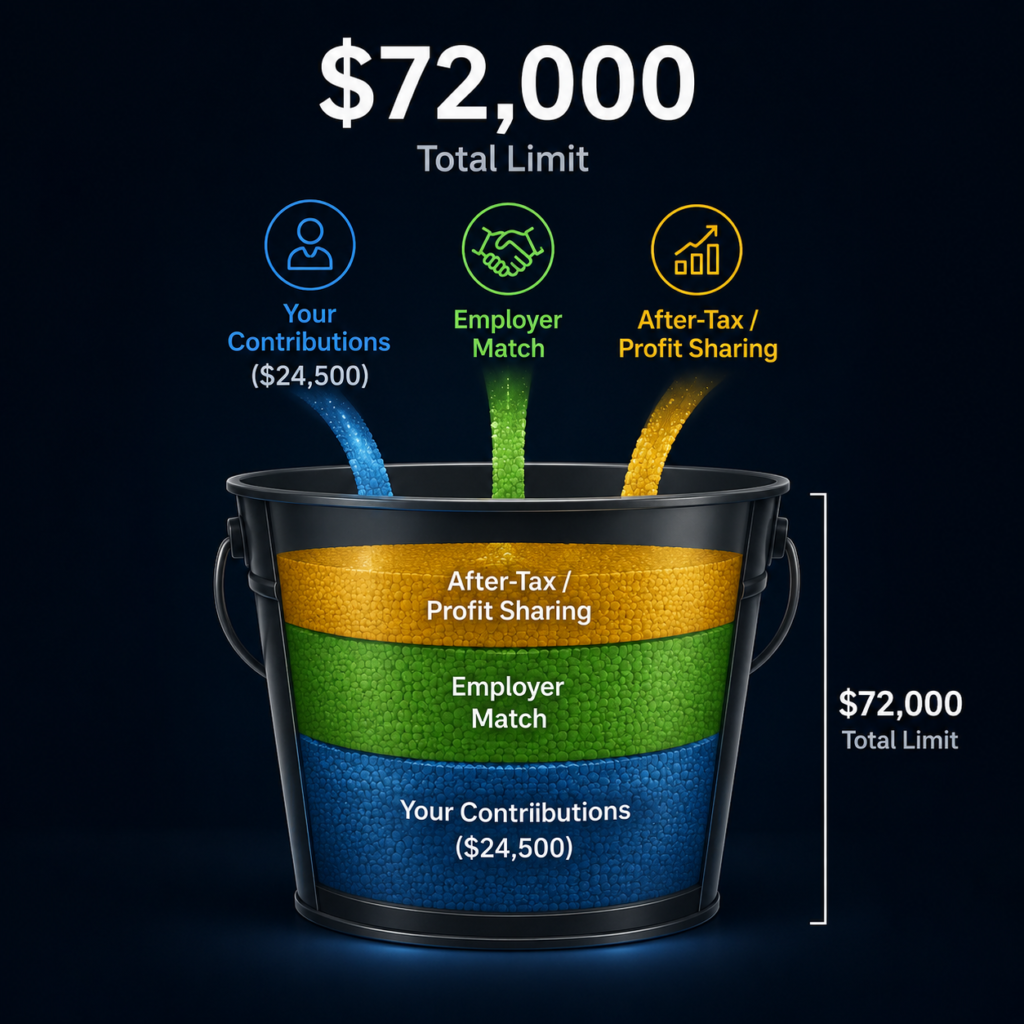
The $24,500 limit is just for your direct paycheck deferrals. The absolute ceiling for what can go into your 401(k) from all sources combined—meaning your contributions, your employer’s matching contributions, and any employer profit-sharing—is $72,000 for 2026.
Why does this matter? Because if you have an incredibly generous employer match, or if your company allows for after-tax non-Roth contributions (which is the foundation of the mega backdoor Roth strategy), this $72,000 ceiling is your true limit.
The New 2026 Catch-Up Rules (And The High-Earner Trap)
If you are 50 or older, the IRS allows you to make “catch-up” contributions to accelerate your savings before retirement. For 2026, there are three totally separate rules you need to understand, including a brand new mandate that is going to create headaches for a lot of people.
The Standard Catch-Up: $8,000
If you are between the ages of 50 and 59, or if you are 64 and older, you can contribute an additional $8,000 to your 401(k) in 2026.
This brings your total employee deferral limit to $32,500, and pushes your combined total limit (including employer money) to $80,000.
The “Super” Catch-Up: $11,250
Thanks to recent SECURE 2.0 legislation, there is now a very specific, four-year window where you get an even larger catch-up allowance. If you are exactly 60, 61, 62, or 63 years old during the 2026 calendar year, your catch-up limit jumps to $11,250.
If you fall into this narrow age bracket, your total employee deferral limit is a massive $35,750. With employer contributions, your combined ceiling hits $83,250.
The New Mandatory Roth Rule
Here is the biggest curveball of 2026.
Starting this year, if your prior-year FICA wages (meaning the wages subject to Social Security and Medicare taxes) from your employer were strictly over $150,000, your catch-up contributions must be made to a Roth account. You are no longer legally allowed to make your catch-up contributions on a pre-tax basis.
I’ve talked to several folks who are panicking about this because they rely on those pre-tax catch-up contributions to keep their taxable income down. If you earned over $150k last year and you are 50 or older, you are going to pay taxes on that $8,000 (or $11,250) this year.
Worse, if your company’s 401(k) plan doesn’t even offer a Roth option yet, you are completely blocked from making catch-up contributions at all until they update their plan. Check with your HR department immediately if you fall into this bucket.
2026 IRA and Roth IRA Limits
While your 401(k) is tied to your job, your Individual Retirement Account (IRA) is entirely in your control. I’ve always viewed the IRA as the best place to hold specialized investments or lower-cost index funds that my workplace plan doesn’t offer.
The Base IRA Limit: $7,500
For 2026, the maximum you can contribute across all your Traditional and Roth IRAs combined is $7,500. If you are 50 or older, you get a $1,100 catch-up, bringing your total to $8,600.
Income Phase-Outs: Who Can Actually Contribute?
This is where people always make mistakes. Just because the limit is $7,500 doesn’t mean you are legally allowed to just drop that money into a Roth IRA or deduct it in a Traditional IRA. The IRS restricts these benefits based on your income.
For a Roth IRA: If you make too much money, you aren’t allowed to contribute directly to a Roth IRA at all. In 2026, those phase-out ranges have increased:
- Single filers: Your ability to contribute starts phasing out at a Modified Adjusted Gross Income (MAGI) of $153,000 and is completely eliminated at $168,000.
- Married filing jointly: The phase-out begins at $242,000 and totally disappears at $252,000.
If you earn above those limits, you shouldn’t just give up on Roth money. You will need to use a backdoor strategy, which involves putting money into a traditional IRA first and then converting it.
For a Traditional IRA: Anyone can put money into a Traditional IRA regardless of income. However, if you or your spouse are covered by a retirement plan at work (like a 401k), your ability to actually deduct that contribution from your taxes phases out based on your income.
- Single filers covered by a workplace plan: The tax deduction phases out between $81,000 and $91,000.
- If you are over that limit, your Traditional IRA contribution becomes non-deductible.
The HSA: The Stealth Retirement Account
I constantly talk about the Health Savings Account (HSA) because I genuinely believe it is the single best investment vehicle in the American tax code. Most people treat it like a checking account for copays and prescriptions. I treat mine strictly as a long-term retirement account.
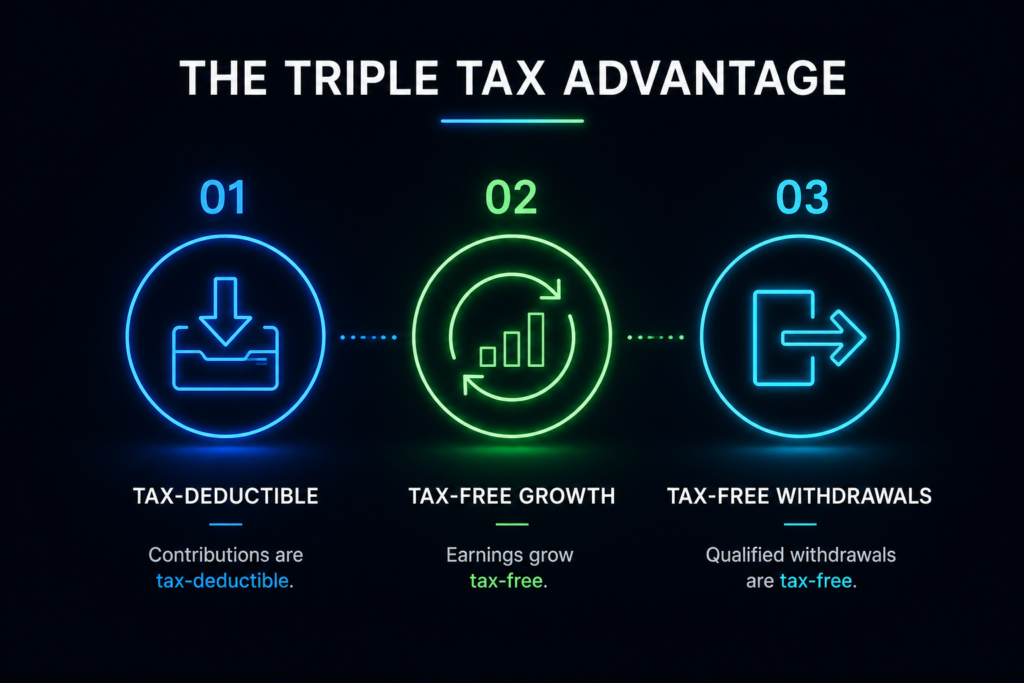
Why? Because it offers a triple-tax advantage: the money goes in pre-tax, it grows completely tax-free when invested, and as long as you spend it on qualified medical expenses, it comes out tax-free. No other account does this.
For 2026, if you have a qualifying High Deductible Health Plan (HDHP), the limits are:
- Self-only coverage: $4,400
- Family coverage: $8,750
- Catch-up (Age 55+): An extra $1,000
I personally pay for my minor medical expenses out of pocket, save the receipts digitally, and leave the money inside my HSA fully invested in a total market index fund. Let it compound for twenty years, and you can reimburse yourself for those old receipts completely tax-free later in life.
Self-Employed Limits: SEP and SIMPLE IRAs
If you run your own business, do freelance work, or have a lucrative side hustle, you have access to different accounts that allow you to shelter a massive amount of income.
SEP IRA: A Simplified Employee Pension (SEP) IRA is entirely funded by the employer (which is you). In 2026, you can contribute up to 25% of your net self-employment compensation, up to a maximum of $72,000. It’s a fantastic, easy-to-manage account for high-earning solo business owners.
SIMPLE IRA: If you run a small business with a few employees, you might use a SIMPLE IRA. The employee contribution limit for 2026 is $17,000 (or up to $18,100 if your employer has a specific “applicable” plan designation).
The “Highly Compensated Employee” Trap
Here is a painful lesson I learned the hard way a few years ago.
I had carefully budgeted to max out my 401(k). About halfway through the year, my HR department sent me an email saying they were legally required to cap my contributions and actually refund some of the money I had already put in.
Why? Because I had crossed the threshold to become a “Highly Compensated Employee” (HCE).
In 2026, the IRS defines an HCE as anyone who earns more than $160,000 or owns more than 5% of the business. By law, a 401(k) plan cannot disproportionately benefit highly paid employees compared to the rest of the staff. If the rank-and-file workers at your company aren’t participating heavily in the 401(k), the IRS forces the company to restrict how much the HCEs can contribute so the plan doesn’t fail non-discrimination testing.
If you make over $160,000, don’t automatically assume you can defer the full $24,500. Check with your benefits administrator to see if your plan historically fails testing. If it does, you’ll need to direct your extra savings into a backdoor Roth IRA or a standard taxable brokerage account.
How I Personally Approach Funding These Accounts
Reading a list of limits is great, but knowing what to do with them is what actually builds a portfolio.
Whenever I get a raise, or whenever a new year begins, I don’t just dump all my money into one place. I follow a very specific waterfall strategy to make sure every dollar is working as efficiently as possible.
Here is the exact order I look at when allocating my retirement savings for 2026:
- The 401(k) Match: I always contribute just enough to my workplace plan to get 100% of the free money my employer offers.
- The HSA: I max out my family HSA limit ($8,750 for 2026) because the triple-tax advantage is mathematically unbeatable. I invest all of it.
- The Roth IRA: I max out my IRA ($7,500). Because I love having tax-free income in retirement, I prioritize this over putting extra into my 401(k). If my income is too high, I use the backdoor method.
- Finish the 401(k): Only after maxing the HSA and IRA do I go back and try to fill up the remainder of my $24,500 401(k) deferral limit.
Your situation might dictate a slightly different path, especially if you are wrestling with whether to choose pre-tax or Roth within your 401(k). But the most important step you can take today is logging into your payroll portal. Look at your current contribution percentage, look at the new 2026 limits, and adjust your math.
Don’t let the IRS give you more room to save without actually taking advantage of it.




No Comment! Be the first one.