

I’ve spent a ridiculous amount of time staring at spreadsheets, trying to pinpoint the absolute perfect day to claim my Social Security benefits.
Table Of Content
When I first started looking closely at my own retirement timeline, I assumed I would just claim the money as soon as the government let me. After all, it’s my money, right? I’ve been paying into the system for decades, and the idea of letting it sit there while I tap into my hard-earned portfolio felt completely backwards.
But the deeper I dug into the math, the more I realized that deciding when to claim Social Security is probably the single biggest guaranteed financial decision any of us will make in retirement. It’s not just a government payout; it’s the foundation of your entire income strategy.
And in 2026, the rules of the game have officially shifted.
This year marks a massive milestone for the Social Security system: the full retirement age (FRA) has officially reached 67 for anyone born in 1960 or later. We have been slowly marching toward this number for years, but now it is finally here. That means the old math your parents or older siblings used to calculate their claiming strategy likely no longer applies to you.
So, let’s break down the real numbers for claiming at 62, 67, and 70. No confusing government jargon—just the practical math, how it actually works, and how I personally look at this decision in my own financial plan.
The 2026 Milestone and Your Full Retirement Age
Before we can talk about claiming early or late, we have to talk about your baseline. In the Social Security world, your baseline is your Full Retirement Age (FRA).
Your FRA is the age at which you are entitled to 100% of your earned benefit. Think of it as the anchor point for all the math that follows. Because the system has been adjusting for longer life expectancies, 2026 is the year that FRA definitively lands on 67 for anyone born in 1960 or after.
Why does this matter? Because every single month you claim before or after your FRA permanently changes the size of your monthly check.
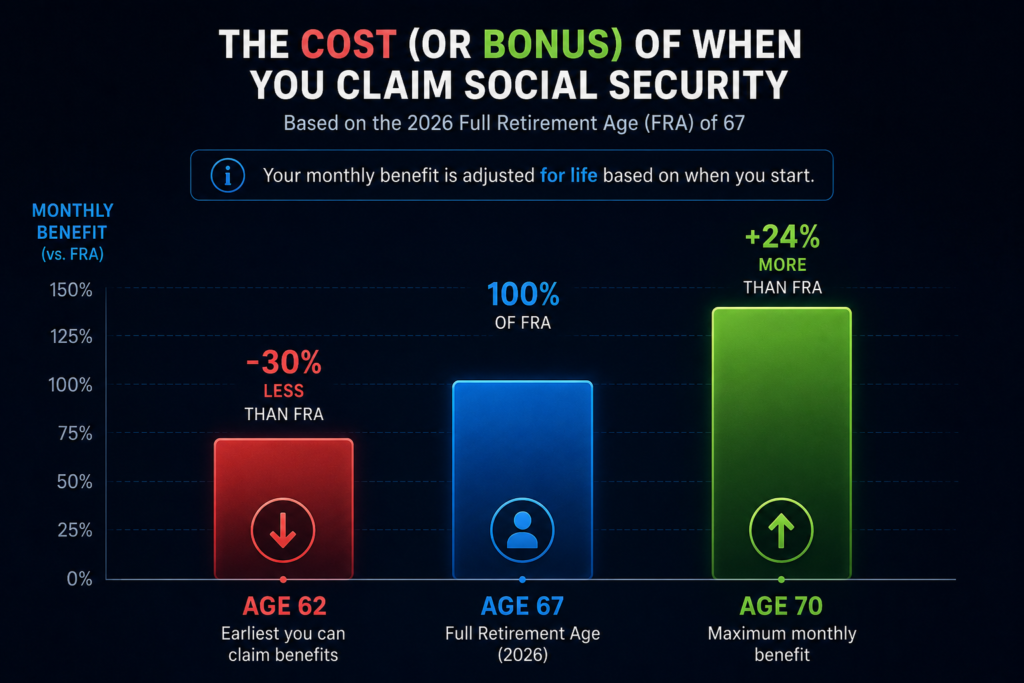
If you claim as early as possible—at age 62—the government doesn’t just hand you your full benefit. They penalize you for taking it early because they expect to be paying you for a much longer period of time. With an FRA of 67, claiming at 62 means your monthly check is permanently reduced by roughly 30%.
Let me repeat that, because it’s a massive hit: taking the money at 62 equals a 30% permanent pay cut for the rest of your life.
On the flip side, the system heavily rewards you for waiting. For every year you delay claiming past your FRA up until age 70, your benefit grows by a guaranteed 8%. In an investing world where we are constantly stressing over unpredictable market returns, a guaranteed 8% annual boost is effectively unheard of.
The Real Numbers: What 62 vs. 67 vs. 70 Actually Looks Like
To truly understand how this plays out, we need to look at the actual dollar amounts.
The Social Security Administration calculates your benefit based on your 35 highest-earning years. For 2026, thanks to a 2.8% cost-of-living adjustment, the average retirement benefit is sitting right around $2,071 per month.
But let’s look at the absolute maximums for a high earner to really see how drastic the claiming age differences are in 2026. If you maxed out your Social Security taxable earnings for 35 years, here is what your monthly check would look like depending on when you pull the trigger:
- Claiming at 62: $2,969 per month
- Claiming at 67 (FRA): $4,207 per month
- Claiming at 70: $5,181 per month
The gap between claiming at 62 and claiming at 70 is over $2,200 every single month. That is an extra $26,000 a year in guaranteed, inflation-adjusted income just for being patient.
When you look at those numbers side by side, it is incredibly tempting to just declare that everyone should wait until 70. But life doesn’t happen in a vacuum, and math doesn’t always account for your health or your immediate need to pay the bills.
This is exactly why we need to calculate your breakeven age.
The Breakeven Framework: Finding Your Crossover Point
The single most common argument I hear for claiming at 62 is, “If I die early, I lose all that money.”
It is a completely valid fear. If you stubbornly wait until 70 to claim, but you pass away at 71, you only collected one year of benefits. You effectively left hundreds of thousands of dollars on the table compared to someone who claimed at 62 and collected checks for nine years.
To make an intelligent decision, you have to find the point where waiting actually pays off. This is your breakeven point—the exact age where the total lifetime amount you collect by waiting surpasses the total amount you would have collected by claiming early.
Here is how the breakeven math typically works out for someone with a Full Retirement Age of 67.
If you compare claiming at 62 versus waiting until 67, your breakeven age is generally around 78 to 79. What this means is that if you live past 79, you will be financially richer for having waited until 67. If you pass away before 78, taking the money at 62 was the better mathematical move.
If you compare claiming at 62 versus waiting all the way to 70, the breakeven point pushes out to roughly 80 to 82.
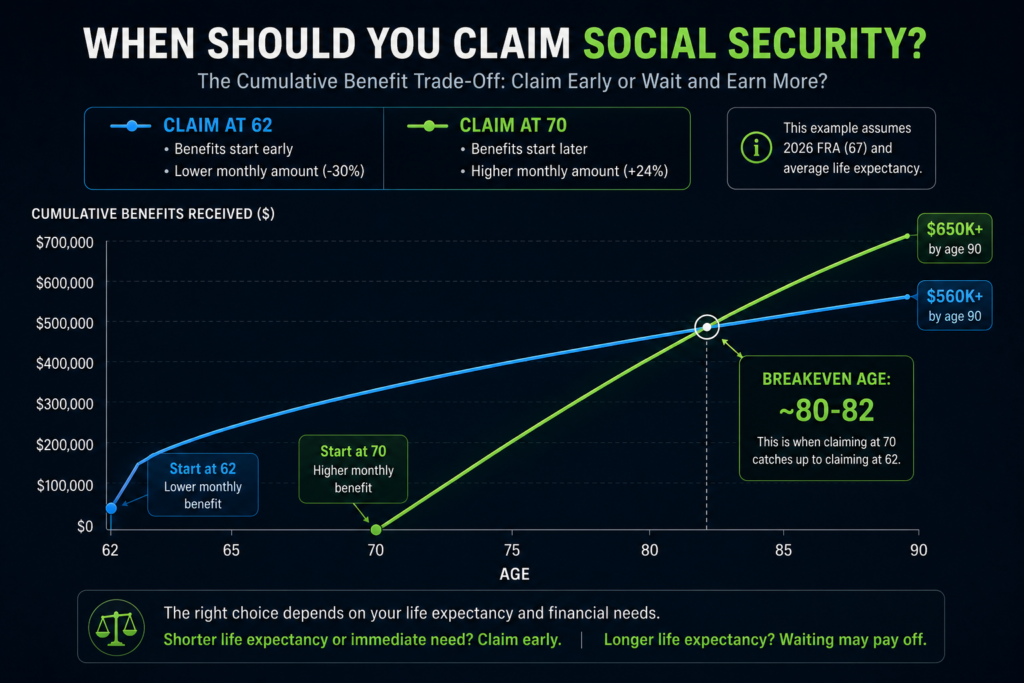
To delay until 70, you need a bridge. You have to fund those eight years of your life from somewhere else. Usually, that means drawing down your 401(k) or IRA heavier than you normally would in your sixties. Psychologically, watching your portfolio balance drop while you wait for the government to pay you is incredibly hard. This is the exact moment where having a solid cash buffer pays off, because it lets you sleep at night while you wait for that 8% annual bump to compound.
Once I grasped this breakeven timeline, my entire perspective shifted. The question is no longer just “when do I want the money?” The question becomes, “do I expect to live past 82?” Actuarially speaking, if you make it to 62 in relatively good health, there is a very high probability you will live well past your early eighties.
When the Math Fails: The Hidden Variables
While the breakeven calculator is a fantastic starting point, I’ve learned the hard way that relying purely on a single data point is a mistake. Real life is far messier than a spreadsheet, and there are a few massive variables that dictate when you should actually claim.
The biggest one is spousal benefits.
If you are married, the rules change drastically. When one spouse passes away, the surviving spouse is allowed to step into the deceased spouse’s benefit amount if it is higher than their own.
This completely changes the risk profile. If you are the higher earner in your household, delaying your benefit to age 70 isn’t just about maximizing your own income; it’s about buying the best possible life insurance policy for your spouse.
When one spouse passes away, the household loses the smaller of the two Social Security checks. But here is the harsh reality: household expenses rarely drop by 50% when a partner passes. Property taxes, utilities, and home maintenance stay exactly the same. By waiting until 70, you are guaranteeing that whoever survives the longest will have the absolute maximum monthly check to live on. In my own household, this realization ended the debate immediately. The higher earner waits.
Another massive variable is whether you plan to continue working.
I see people constantly make the mistake of claiming at 62 just because they reached the age, even though they are still working a full-time job. In 2026, if you are under your Full Retirement Age and you earn more than $24,480, the government will withhold $1 in benefits for every $3 you earn above that limit.
While those withheld funds aren’t permanently lost—they are factored back into your check once you finally reach FRA—it largely defeats the purpose of claiming early to generate immediate cash flow. If you are still working and making decent money, claiming early is almost always a mistake.
How I Personally Look at the Decision
After years of mapping out different withdrawal strategies and running endless retirement simulations, my personal philosophy on Social Security has evolved.
I no longer view it as an investment that I need to squeeze a perfect return out of. I view it as longevity insurance.
The biggest fear most retirees have is outliving their money. If I live to be 75, I really won’t care that I didn’t optimize my Social Security breakeven point, because my personal investment portfolio will easily cover a shorter retirement.
But what if I live to 95?
If I make it to 95, decades of inflation will have eroded the purchasing power of my savings, medical costs will likely be peaking, and my portfolio might be running dangerously thin. In that specific scenario, having a massive, guaranteed, inflation-adjusted check of $5,000+ hitting my bank account every single month is exactly what will save me from financial ruin.
Waiting until 70 transfers the risk of living a remarkably long life from my personal portfolio to the federal government.
For my own plan, unless a terminal health diagnosis forces my hand, or a catastrophic market crash requires me to generate immediate alternative income to avoid selling stocks at a loss, I am delaying my claim as long as possible. I want the absolute maximum guaranteed baseline.
Your Immediate Next Steps
Deciding when to claim shouldn’t be done in a panic on the eve of your 62nd birthday.
Start by logging into your account on the official SSA website to pull your actual statement. Look at your specific Full Retirement Age, and write down your estimated benefits at 62, 67, and 70.
Next, have an honest, potentially uncomfortable conversation about your health history and your family longevity. Are you realistically planning for a 30-year retirement?
Lastly, take the time to map out how this guaranteed income interacts with the rest of your assets. Knowing your numbers allows you to step back, look at the big picture, and confidently pull the trigger when it actually makes sense for your specific life—not just what the standard benchmarks tell you to do.





No Comment! Be the first one.