

I vividly remember sitting at my kitchen table a few years ago, staring at a retirement calculator, and realizing I was behind. Life happens – mortgages, raising kids, unexpected medical bills – and suddenly you find yourself in your late 40s wishing your 401(k) balance had an extra comma in it.
Table Of Content
- The Baseline: How Catch-Up Contributions Work in 2026
- The “Super” Catch-Up: A 4-Year Window for Ages 60-63
- The 2026 High-Earner Roth Mandate (The Big Trap)
- How the $150,000 Threshold Actually Works
- The Hidden Danger: What If Your Plan Doesn’t Have a Roth Option?
- How I Personally Adjust My Strategy
- A Note on IRAs
- Wrapping It Up
That’s when I first learned about the magic of catch-up contributions. Once you hit 50, the IRS suddenly lets you shovel significantly more money into your retirement accounts. It’s a financial lifeline. It was exactly what I needed to bridge the gap between where my portfolio was and where I wanted it to be.
But if you are turning 50, or are already in your 50s and 60s, the rules of the game are changing dramatically in 2026.
Congress recently passed a massive piece of legislation called SECURE 2.0, and hidden inside it are two massive shake-ups for older investors. First, they are introducing a brand new “super” catch-up tier for people in their early 60s. Second – and this is the trap I see so many people walking directly into – if you are a high earner, the IRS is entirely taking away your ability to make pre-tax catch-up contributions.
Starting in 2026, you might be forced to make your catch-ups using after-tax Roth dollars.
Let’s walk through exactly how these new 2026 rules work, the tax traps to watch out for, and how I personally navigate this in my own portfolio.
The Baseline: How Catch-Up Contributions Work in 2026
Before we get into the complicated new mandates, let’s quickly review the baseline rules, because the numbers have gone up.
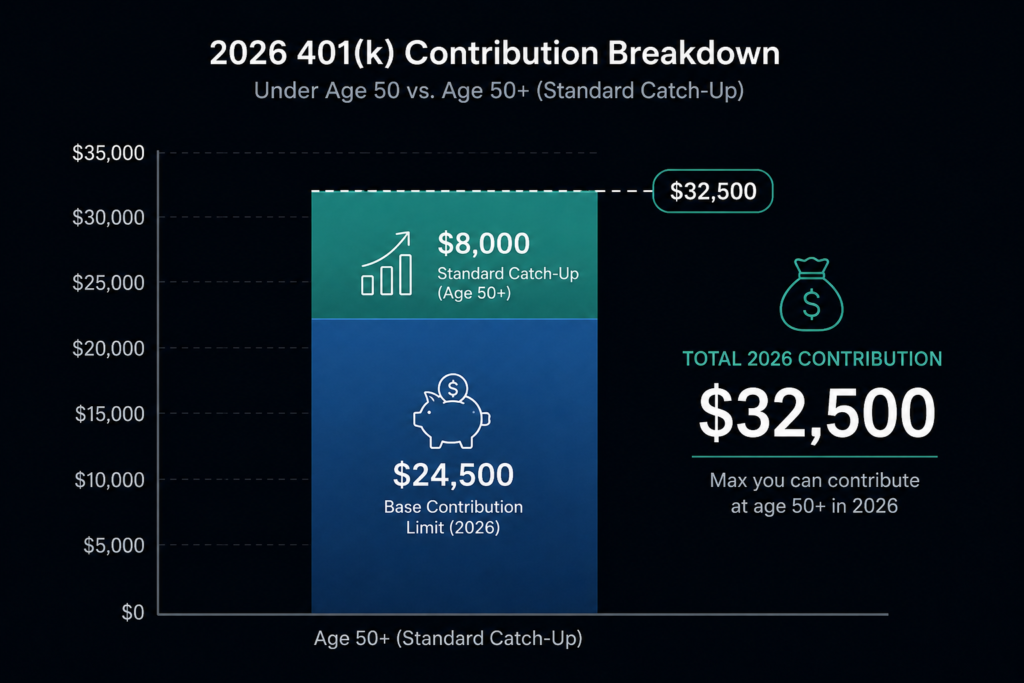
In 2026, the standard employee limit for 401(k), 403(b), and 457 plans is $24,500. That is the maximum amount of your own salary you can defer into your workplace plan, regardless of your age.
But the year you turn 50, a new door opens. The IRS allows you to make an additional “catch-up” contribution. For 2026, that standard catch-up amount is $8,000.
That means if you are 50 or older, you can pack a total of $32,500 of your own money into your 401(k) this year.
Why does this matter so much? Because your 50s are typically your peak earning years. The kids might be finishing college, the house might be getting closer to paid off, and you finally have excess cash flow. Pushing an extra $8,000 a year into the market for a decade before you retire can drastically alter your lifestyle in your 60s and 70s.
But not everyone over 50 gets the same limit anymore.
The “Super” Catch-Up: A 4-Year Window for Ages 60-63
This is where things get genuinely interesting. Starting in 2025, and continuing into 2026, Congress created a special, elevated tier of catch-up contributions for a very specific age bracket: ages 60, 61, 62, and 63.
If you fall into this four-year window in 2026, your catch-up limit isn’t $8,000. It jumps to $11,250.
Add that to your base contribution limit of $24,500, and a 60-to-63-year-old can stash a massive $35,750 into their 401(k) this year.
When I look at this rule, I see it as Congress acknowledging reality. People in their early 60s are often staring down the barrel of retirement, realizing they are just a few years away from needing to live off their portfolio. This four-year “super” catch-up window is designed to let you sprint to the finish line.
However, you have to be careful with the timing. This super catch-up window firmly shuts the year you turn 64. At 64, your catch-up limit drops back down to the standard $8,000 amount. It’s a narrow window, so if you are turning 60 this year, you need to proactively go into your HR portal and bump up your contribution percentages to take advantage of it.
The 2026 High-Earner Roth Mandate (The Big Trap)
Now we arrive at the biggest change – and the one that is going to blindside a lot of investors who aren’t paying attention.
Historically, you always had a choice. You could make your catch-up contributions with pre-tax dollars (lowering your tax bill today) or with Roth dollars (paying taxes today for tax-free growth tomorrow). I’ve historically loved using pre-tax catch-ups during my high-earning years to keep my tax bill manageable.
Starting in 2026, if you are a high earner, that choice is gone.
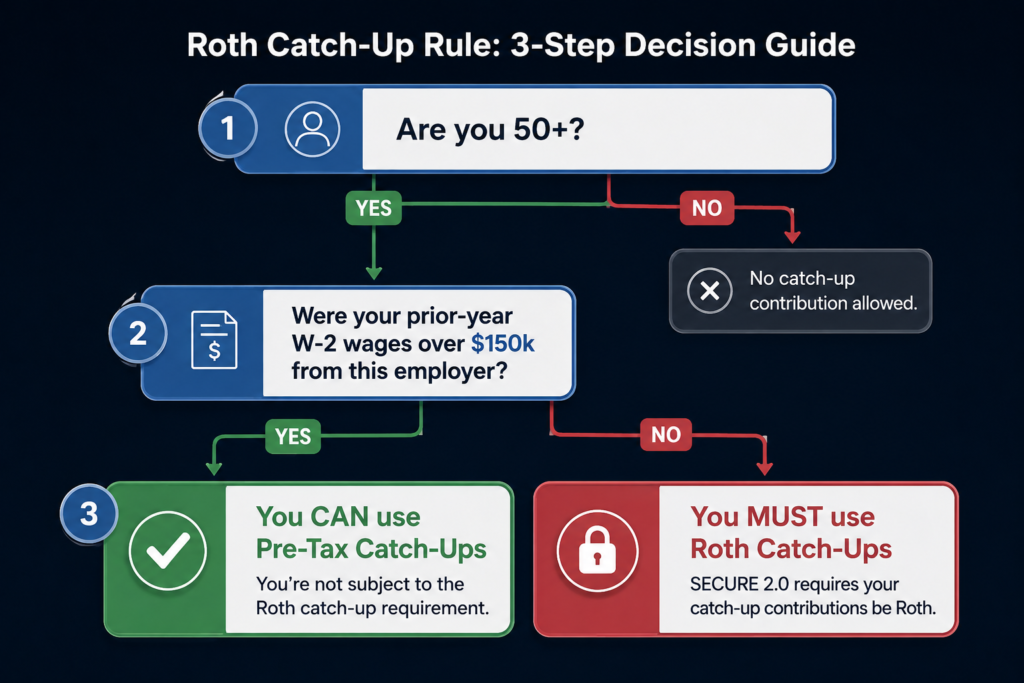
Here is the exact rule: If your prior-year FICA wages from your employer were over $150,000, all of your catch-up contributions must be made as Roth contributions.
Congress needs tax revenue right now to pay for other programs. By forcing high earners to use Roth accounts for their catch-up money, the government gets to tax that $8,000 (or $11,250) right now, rather than waiting until you retire.
How the $150,000 Threshold Actually Works
The way this rule is written trips up a lot of people, so let’s break it down in plain English.
The IRS is looking at your prior-year FICA wages. This means your 2025 income dictates your 2026 rules.
Furthermore, it is strictly based on wages subject to Social Security and Medicare taxes (the amount in Box 3 of your W-2) from the specific employer sponsoring your plan.
Here is what that means in practice:
- It is not based on your Adjusted Gross Income (AGI).
- It does not include your spouse’s income.
- It does not include capital gains, rental income, or side-hustle money.
If you earned $140,000 at your corporate job in 2025, but your spouse earned $100,000, your household income is well over the limit. However, because your individual W-2 wages from that employer were under $150,000, you are totally exempt from this rule in 2026. You can still make pre-tax catch-ups.
But if your W-2 wages from your employer were $155,000 last year, every single catch-up dollar you contribute this year must go into the Roth side of your 401(k).
The Hidden Danger: What If Your Plan Doesn’t Have a Roth Option?
This brings us to a massive, hidden issue that I’ve been warning my investing circles about.
Not every 401(k) plan offers a Roth option. Many smaller employers only offer traditional, pre-tax 401(k)s.
Under the new 2026 rules, if you earn over $150,000, and your employer does not offer a Roth 401(k) option, you are legally barred from making catch-up contributions entirely. The IRS essentially says, “If you can’t put it in a Roth, you can’t put it in at all.”
Worse, the rule is actually a plan-wide mandate. If a plan doesn’t offer a Roth option, nobody in the company can make catch-up contributions, regardless of their income level.
If you are a high earner and you rely on those catch-up contributions to hit your retirement numbers, you need to email your HR department today. Ask them, “Does our 401(k) plan currently accommodate Roth contributions, and are we compliant with the SECURE 2.0 catch-up mandate?” If they aren’t, they need time to update the plan documents before 2026 begins.
How I Personally Adjust My Strategy
When the rules change, your strategy has to adapt. Here is exactly how I look at this shift.
First, I separate my base contributions from my catch-ups. If I am forced to make my catch-up contributions in Roth dollars because of the $150k rule, I don’t panic. I just remember that my first $24,500 can still be entirely pre-tax.
This actually forces a bit of “tax diversification” onto your portfolio, which isn’t a bad thing. Having a mix of pre-tax and Roth money in retirement gives you incredible flexibility to control your tax brackets when you eventually start pulling the money out.
Second, I automate the switch. The moment I realize I will cross that $150,000 threshold in a given year, I go into my payroll system for the following year and ensure my standard deferrals are set the way I want them, and my catch-up deferrals are explicitly routed to the Roth bucket. If you let the system default, and your employer’s software isn’t updated, you risk having the excess contributions rejected and returned to you as taxable income.
A Note on IRAs
It’s important to note that this $150,000 Roth mandate currently applies to workplace plans like 401(k)s, 403(b)s, and 457s.
If you are making catch-up contributions to an Individual Retirement Account (IRA), the rules are different. The IRA catch-up limit for 2026 is $1,100 (for a total of $8,600). The SECURE 2.0 Roth mandate does not apply to IRA catch-ups. You can still make those in a traditional IRA if you prefer, assuming you meet the standard deductibility rules.
Wrapping It Up
Catch-up contributions remain one of the most powerful tools you have in the decade before you retire. When I was younger, I used to think of them as just a nice little bonus. Now, I view them as an essential sprint.
Yes, the 2026 rules are more complex. Yes, the government forcing high earners into Roth catch-ups feels restrictive. But the alternative – not taking advantage of this tax-advantaged space at all – is a far worse financial mistake.
Determine your age bracket, check your 2025 W-2 income to see if you hit the $150,000 threshold, verify your employer offers a Roth option, and automate your contributions. The peace of mind you’ll have knowing you are maximizing every single dollar allowed by law is worth the hour of administrative headache it takes to set it up.




No Comment! Be the first one.